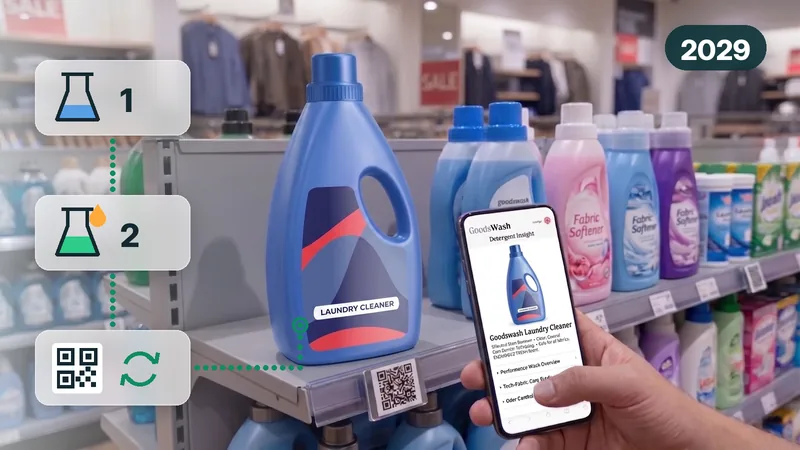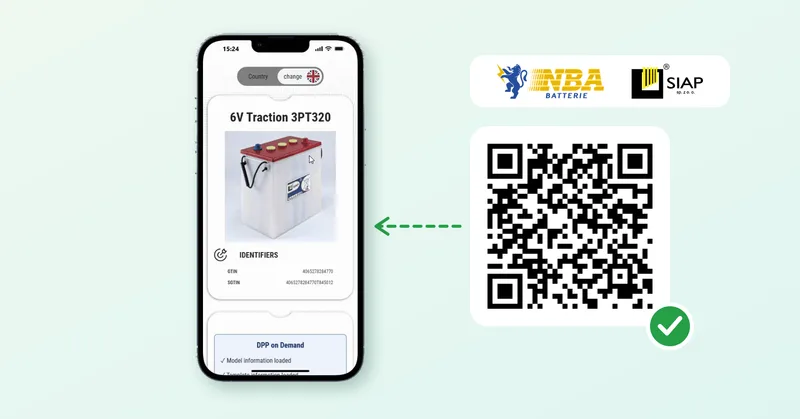

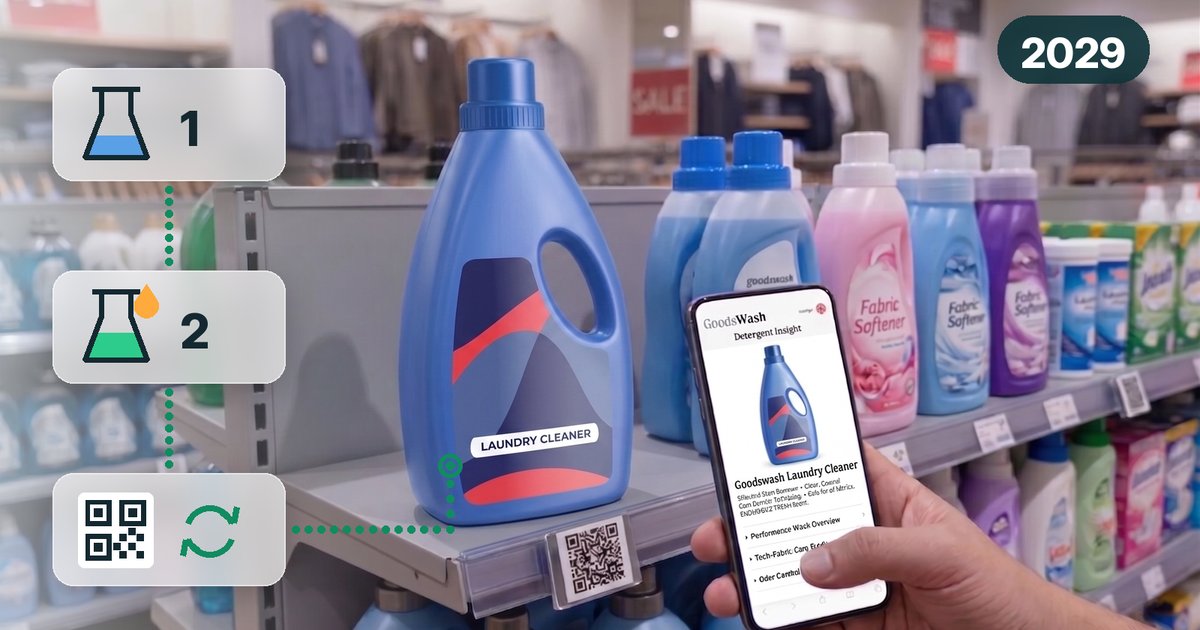
The new EU Detergents Regulation brings the logic of the Ecodesign framework into the chemical and consumer goods sector. Regulation (EU) 2026/405 was published in the Official Journal on 2 March 2026, entered into force on 22 March 2026 and applies from 23 September 2029. From that date, a manufacturer must create a digital product passport (DPP) before placing a detergent or end-user surfactant on the EU market.
The regulation ties that passport to the product model, not to each bottle or serial number. That sounds administratively simpler than the item-level passports required for many batteries. In practice it moves the difficulty somewhere else: to formulation agility. Detergent formulas change often, for cost, supply, performance or regulatory reasons, and each change raises the same question: is this still the same model?
1. What the regulation requires for the passport
Article 21 sets out the core obligation. Before placing a detergent or end-user surfactant on the market, the manufacturer creates a digital product passport. It must:
- correspond to a specific model of detergent or end-user surfactant (Art. 21(2)(a));
- state that compliance with the regulation has been demonstrated;
- contain at least the data in Annex VI, Part A, including the trade name, the unique product identifier, a colour image of the packaging or label, the manufacturer's details and unique operator identifier, and a full list of intentionally added substances;
- be accurate, complete and up to date (Art. 21(2)(d));
- remain available for 10 years after the product is placed on the market, including if the economic operator becomes insolvent or stops operating in the EU (Art. 21(2)(g));
- be connected through a data carrier, printed on the label or packaging, to a persistent unique product identifier.
By creating the passport, the manufacturer assumes responsibility for the product's compliance (Art. 21(9)). The economic operator placing the product on the market must also make a back-up copy available through a digital product passport service provider (Art. 21(12)(c)). Where another EU law requires a passport at batch or item level, the detergents passport may follow that level (Art. 21(7)); otherwise, the model is the unit.
2. When is a reformulated product a new model?
The regulation answers this in recital 45: detergents should be considered as belonging to the same model "as long as there are no changes to the formula or to the production that would lead to modifications in the label of the products".
The label is therefore the test. Annex V, Part A lists what the label must show, among other things:
- weight-percentage ranges for constituents such as phosphates, phosphonates, the four surfactant classes, bleaching agents and soap, where they are added above 0.2%;
- enzymes, micro-organisms, optical brighteners and perfumes, whatever their concentration;
- certain preservatives;
- fragrance allergens from the list in Part D, where intentionally added above 0.01% by weight;
- the unique formula identifier (UFI) for poison centre notifications.
A change in surfactant concentration that moves a constituent into another range, a new enzyme or preservative, or a fragrance that adds an allergen above the threshold changes the label. So does a reformulation that requires a new UFI under the CLP Regulation. Under recital 45, the result is a new model, which needs its own passport.
When that happens, Article 22(f) requires the new passport to be linked to the original one. And under Article 8(3), manufacturers must keep and, where necessary, update both the technical documentation and the passport for 10 years. In other words, the passport history has to follow the formulation history.
3. The registry and customs make the model visible at the border
The passport does not stand alone. Before placing a product on the market, the relevant economic operator uploads its unique product identifier and unique operator identifier to the EU registry established under Article 13 of the ESPR (Art. 24(1)). For products to be released for free circulation, the registry also stores the commodity code. The registry then returns a unique registration identifier. That identifier is not proof of compliance (Art. 24(2)).
Article 25 connects this to customs. Anyone placing a detergent under the customs procedure "release for free circulation" must give customs the unique registration identifier. Customs may release the product only after verifying, as a minimum, that the identifier and the commodity code match the data stored in the registry (Art. 25(3)). The check runs electronically through the link between the registry and the EU Customs Single Window Certificates Exchange System, from 23 September 2029 or from the date that link is operational, whichever is later (Art. 25(4)).
For importers, the practical consequence is clear: a new model that has not been registered, or a shipment declared with identifiers that do not match the registry, will not pass this check. The registration data has to keep pace with the formulation changes on the production line.
We explain what the EU registry checks, and what it does not, in The EU Digital Product Passport Registry Is Live: What Does It Actually Validate?
4. What this means for daily operations
For a brand with a large and frequently reformulated portfolio, model-level compliance becomes a continuous process rather than a one-off project. Three areas need attention.
Formulation triggers. Regulatory, R&D and production teams need a shared rule for when a change affects the label. Changes that stay within the same label content can update the existing passport. Changes that alter the label start a new model, a new passport and a new registration.
Registry updates. Each new model needs its identifiers in the registry before it is placed on the market. Doing this by hand for every variant and market does not scale. An API-based connection between the product data system and the registry avoids delays.
Consistent data across label, passport and registry. The physical label, the passport content, the registry entry and the customs declaration describe the same product. If they are maintained in separate tools, they drift apart. The safest approach is one source of formulation data that feeds all of them.
Chemical brands that rely on manual documentation to update their product declarations will feel this most as formulation cycles accelerate. Building the data structures now, well before September 2029, leaves time to test them.
5. What is still to come
Some technical details are not fixed yet. The Commission must adopt an implementing act on the basic technical requirements of the detergents passport, including the data carriers, access rights and who may create or update passport data (Art. 21(10)). That act cannot apply earlier than 18 months after it enters into force, except in duly justified cases. The data carriers, unique product identifiers and unique operator identifiers must follow the standards applicable under the ESPR (Art. 23(1)).
Products placed on the market before 23 September 2029 in compliance with the old Regulation (EC) No 648/2004 may remain on the market (Art. 36).
How GoodsTag helps
GoodsTag manages digital product passports at model, batch or item level, with versioning and links between passport generations. For detergents this means:
- formulation data and label content kept in one place, so a label-relevant change is visible immediately;
- a new passport generated and linked to the previous one when a new model is created;
- registry integration via API, in preparation as the EU interfaces are finalised;
- a back-up copy of the passport through a digital product passport service provider;
- data carriers such as QR codes following GS1 Digital Link.
Can your regulatory team update and register a digital product passport as fast as your factory changes a fragrance profile? If not, now is the time to set up the process. Contact GoodsTag to discuss your detergent portfolio.
Sources
- Regulation (EU) 2026/405 on detergents and surfactants, recital 45; Articles 8, 21, 22, 23, 24, 25, 36 and 37; Annexes V, VI and VII
- Regulation (EU) 2024/1781 (Ecodesign for Sustainable Products Regulation), Article 13 (digital product passport registry)
- Regulation (EC) No 1272/2008 (CLP), Annex VIII (unique formula identifier)
- Legislative Observatory: procedure 2023/0124(COD)
Last regulatory review: 26 October 2026. The implementing acts under the Detergents Regulation had not been adopted at that date. This article is not legal advice.