
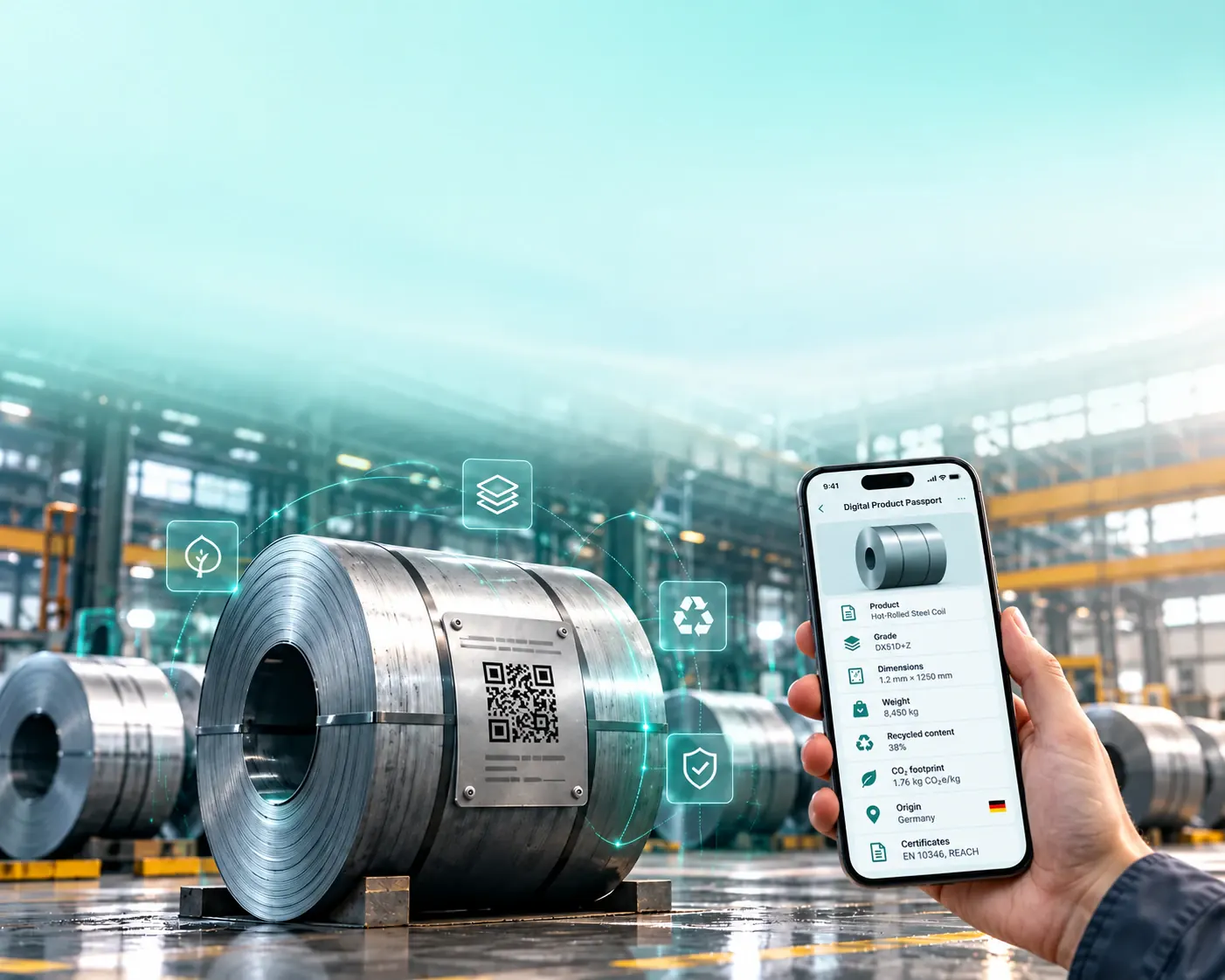
Iron & Steel DPP: Build Digital Product Passports with GoodsTag
GoodsTag provides the infrastructure to create and manage Digital Product Passports for iron and steel products.
What’s Inside an Iron & Steel Digital Product Passport?
Steel is everywhere: in buildings, cars, machines and packaging. That is why iron and steel are among the first intermediate products the EU is addressing under the Ecodesign for Sustainable Products Regulation (ESPR). The regulation is already in force. The European Commission is now preparing a delegated act for iron and steel products that will define low-carbon steel, set ecodesign requirements and improve access to sustainability information along the value chain.
The delegated act will define the exact data set. Based on what the European Commission has outlined so far, a steel passport may draw on:
-
Identity
Unique product identifier, product type and classification, steel grade, dimensions, batch or heat number, responsible economic operators
-
Material and Composition
Technical and material data, chemical composition, substances that may hinder recycling
-
Carbon Footprint
Greenhouse gas emissions from production, the basis on which the EU will define low-carbon steel
-
Recycled Content and Circularity
Share of recycled content and scrap, information that supports recycling at end of life
-
Compliance and Traceability
Documentation relevant to compliance and traceability, such as inspection certificates and origin information
All structured, machine-readable, and ready for customers, recyclers and authorities further down the value chain.
Need Clarity on Iron & Steel DPP Requirements?
The requirements are still being drafted. We follow every step so you don't have to.
Digital Product Passport
Iron & Steel DPP Experts, Ready to Work With Your Team
End-to-end support to simplify your DPP rollout.

What’s Getting in the Way of DPP Success?
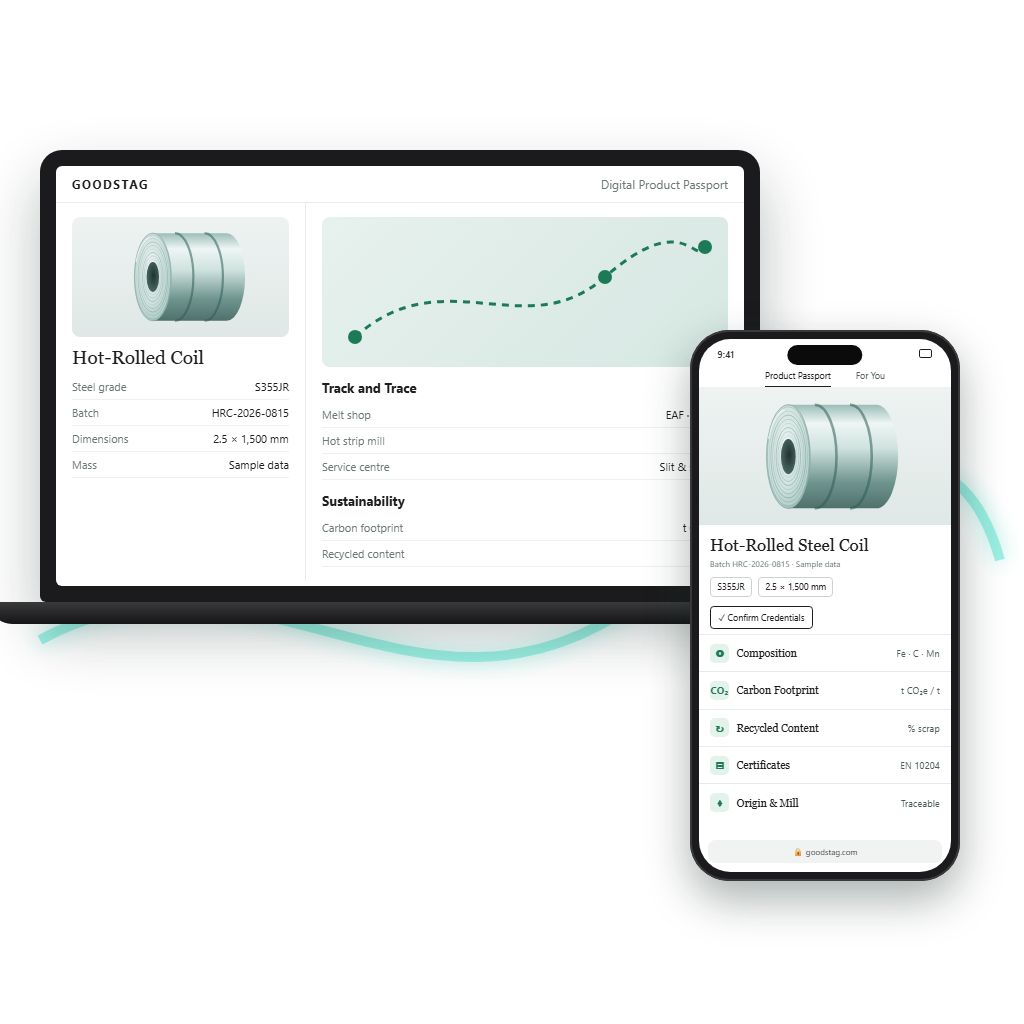
From the melt shop to the customer, a steel passport depends on data spread across the whole value chain.
-
Emissions data spread across plants and systems
-
Scrap and recycled content that is hard to trace
-
Inconsistent certificates, formats and documentation
-
Product data that changes with every heat and batch
-
Unclear internal ownership
Why Leading Teams Choose GoodsTag for DPPs

Full Lifecycle Support
Your DPP stays accurate through supplier changes, new grades, and evolving regulations.

Built for Scale
Handles high volumes of coils, plates, bars and batches across sites and suppliers.

Compliance in Mind
Your data model follows the EU requirements as they are finalised, and your data stays structured for audit-ready reporting.

Proven Partner
Proven track record in high-stakes, high-volume environments.
Request a live demo
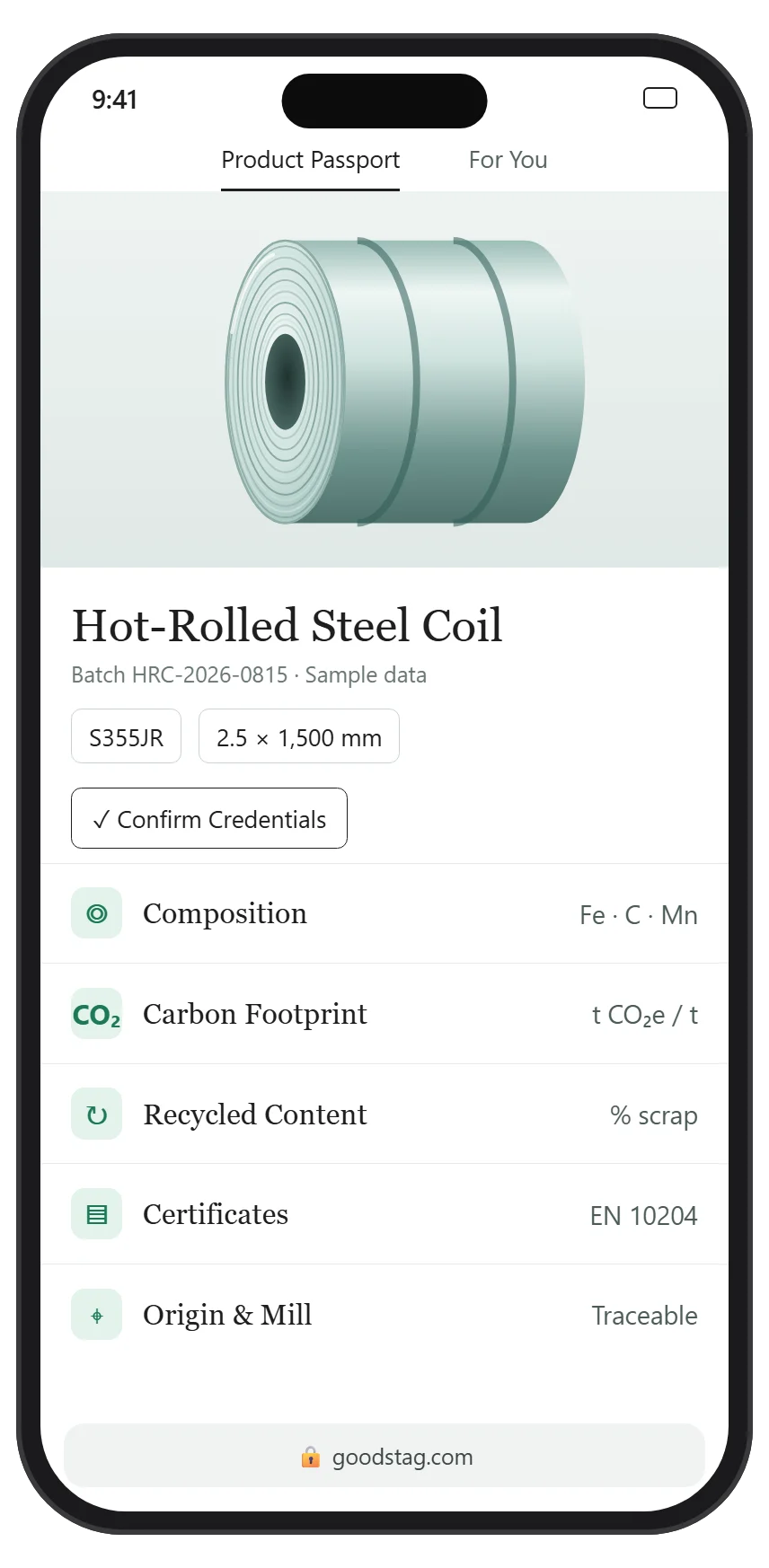
What Could an Iron & Steel DPP Look Like?
Your customers and recyclers won't dig through a mill certificate. They'll scan a QR code on the coil or its label.
Here's an example of what they (and authorities) could see on the other side. Sample data only.
Want to see it with your own products? [Talk to us]
The Deadlines Are Closer Than You Think
Under the EU's Ecodesign for Sustainable Products Regulation (ESPR), Digital Product Passports for iron and steel are on their way. The delegated act has not been adopted yet, but it is the next step, and the preparation window is short.
Here are the key dates you need to know about (indicative, as of October 2026):






When to Start?
Our honest take: yesterday. Realistically: right now.
Every month you wait is a month less to connect plants and suppliers, clean data, and test your publishing workflow before the requirements apply. GoodsTag makes the first step manageable.
How We Help You Build Your Iron & Steel DPP
A simple, practical path for steel producers, importers and processors.

Map the data you already have
Lay out all existing data across ERP, MES, laboratory systems, spreadsheets and certificates to see where each field currently lives.

Identify missing information
Spot the gaps by separating usable data from incomplete, messy, or missing information, from emissions to scrap shares.

Define internal ownership
Assign clear owners for each data area so updates and approvals have defined responsibility.
Align your structure with the EU data model
Match your internal fields to the EU DPP data model so everything aligns with required domains and formats.

Create a publishing workflow
Set a structured workflow for validating, approving, and publishing data into the DPP.

Plan for ongoing updates
Establish routines and triggers to keep the passport continuously updated with every heat, batch and shipment.
Compliance Without Headaches
Turn the EU iron and steel DPP requirements into a competitive advantage, today.
Frequently Asked Questions
1. What exactly is an Iron & Steel Digital Product Passport (DPP)?
A Digital Product Passport is a structured, machine-readable data set that stores verified product information across a steel product's lifecycle. For iron and steel, it is how producers and importers will meet the passport requirements of the EU Ecodesign for Sustainable Products Regulation (ESPR): the regulation is already in force, and a delegated act for iron and steel products will set the exact data and the date from which the passport is mandatory.
2. Is there already a binding DPP regulation for iron and steel?
Not yet. As of October 2026, the European Commission is preparing a delegated act for iron and steel products under the ESPR, Regulation (EU) 2024/1781. The call for evidence and public consultation ran from 20 May to 12 August 2026, and adoption is planned for the fourth quarter of 2026. The requirements apply at least 18 months after the act enters into force.
3. Which products and companies will be affected?
The delegated act covers iron and steel products, which the EU treats as intermediate products: steel that is processed further into components and finished goods. The European Commission expects the requirements to apply to manufacturers, producers, importers and other economic operators placing covered products on the EU market. The exact product scope will be set in the act.
4. What information will the passport contain?
The exact data set will be defined in the delegated act. The European Commission has indicated product identification and classification, technical and material data, information supporting circularity such as recycled content, sustainability information, and documentation relevant to compliance and traceability. The initiative will also define low-carbon steel, so carbon footprint data is likely to play a central role.
5. How does the steel DPP relate to CBAM?
They are separate instruments. The Carbon Border Adjustment Mechanism, Regulation (EU) 2023/956, puts a carbon price on imports of iron and steel and has been in its definitive period since 1 January 2026. The DPP will carry product information along the value chain. Both rely on emissions data from production, so collecting that data once and structuring it well serves both.
6. How do we connect physical steel products to the digital passport?
GoodsTag assigns a unique digital identity to each product, batch or heat. This identity is connected to the physical product via QR codes, DataMatrix, NFC or RFID labels on the coil, the bundle or its tag. When scanned, the identifier routes the user to the product's digital twin, which hosts the verified DPP data set.
7. Is the GoodsTag platform ready for the upcoming requirements?
The delegated act for iron and steel under the EU ESPR has not been adopted yet, so no platform can claim full compliance with it today. GoodsTag builds on the principles the ESPR already sets for passports: a unique product identifier, a data carrier on the product, open and interoperable formats, and access rights for customers, recyclers and authorities. The platform is based on GS1 Digital Link. Its data models are configurable, so the steel data set can be mapped as soon as the delegated act defines it. All compliance data can be cryptographically signed, securely shared with authorities, and structured for audit-ready reporting.
8. How do we feed all this data into the GoodsTag platform?
GoodsTag features an API-first architecture that integrates with your existing enterprise systems, including ERP, MES, laboratory systems, PLM and supplier databases such as SAP S/4HANA. Data synchronization is event-driven and supports global GS1 standards like EPCIS 2.0 and GS1 Digital Link for real-time traceability.
9. Can the platform handle high-volume steel production?
Yes. The GoodsTag infrastructure is cloud-native and built on a microservices architecture designed for horizontal scaling. It handles high-volume serialization and global scanning volumes, so producers can manage large numbers of coils, plates, bars and batches across several sites without compromising speed.
10. Do we need item-level serialization from day one?
No. GoodsTag has a modular design, so you can start at any point. Begin with digital twins at product, batch or heat level and expand to finer identification as operational readiness grows. With an API-first architecture and data mapping templates, the platform can be deployed quickly alongside your existing ERP and production systems.

The Producers That Move First Will Set the Standard
Build your market position on top of compliance.
The DPP will make the sustainability data of steel visible to every customer. The producers that get there first will use it to do something more: prove low-carbon credentials, earn trust, and turn supply chain data into a competitive edge.