


Detergent DPP: Build Digital Product Passports with GoodsTag
What’s Inside a Detergent & Surfactant Digital Product Passport?
The Digital Product Passport for detergents and surfactants is the EU's way of making every cleaning product transparent, safe, and environmentally accountable: from the raw surfactant synthesis to the wastewater treatment facility where it drains. It's a strict legal mandate, and by summer 2029, it will be mandatory for every brand on the EU marke
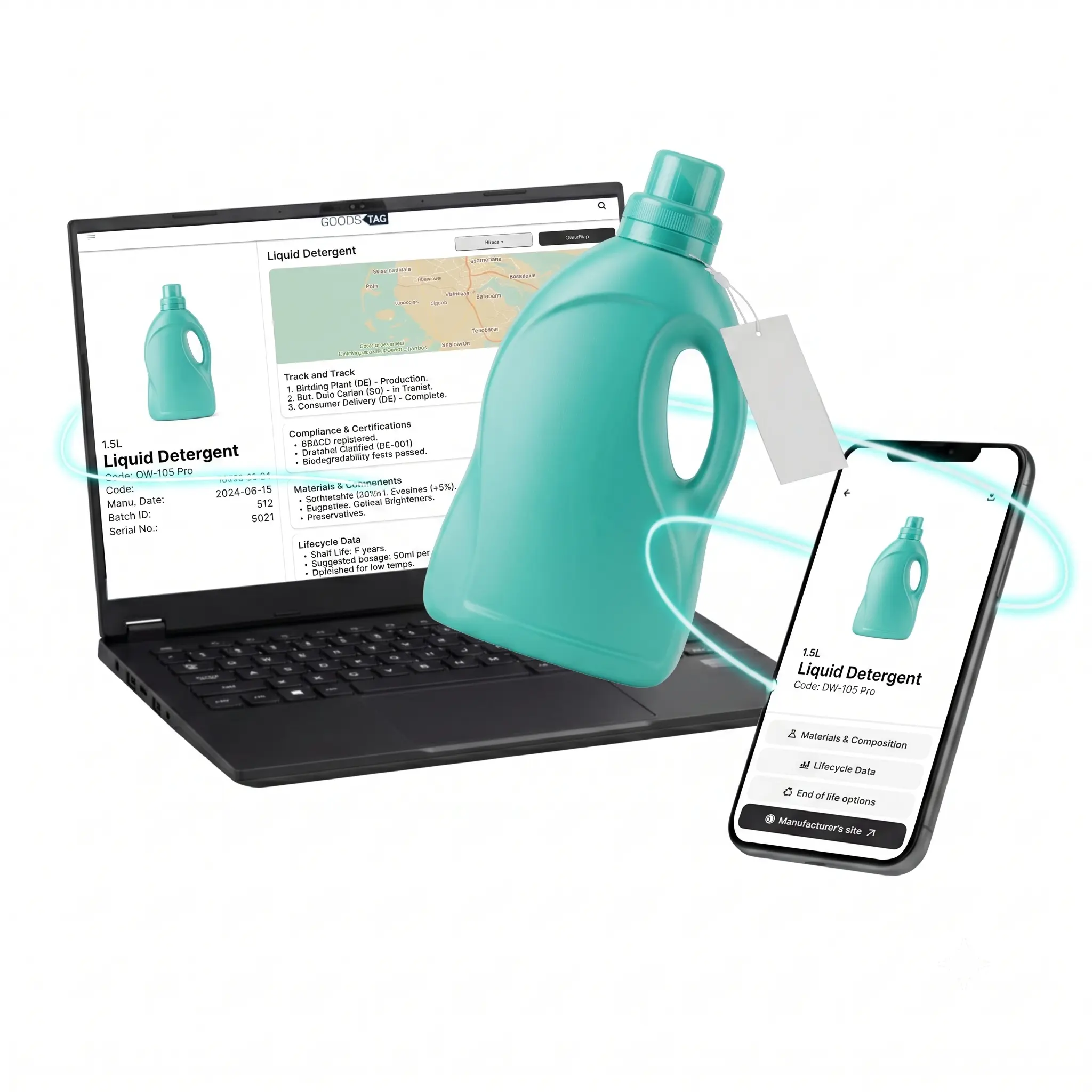
Each digital product passport should include:
Identity
Unique product, operator, and formulation identifiers (UPID, EOID, and UFI) to guarantee instant safety data retrieval by poison centres in medical emergencies
Performance & Composition
Full digital disclosure of all ingredients, fragrance allergens, and strain-level taxonomic safety profiles for microbial cleaning products
Environmental Footprint
Verification of aerobic biodegradability for surfactants and capsule films, alongside strict phosphorus limits to prevent aquatic eutrophication
Circularity, Usage & Refill
Smart dosage grids to prevent chemical overuse and paperless safety data delivery for packaging-free refill stations
Supply Chain and Traceability
Chemical facility mapping linked to a registration identifier for automated EU customs border checks via the Single Window
All this data is available in a machine-readable format: ready to use for regulatory authorities, poison centres, customs authorities, and your entire value chain.
Need Clarity on Detergent & Surfactant DPP Requirements?
The regulatory landscape is shifting. We’ve decoded the complex chemical and biological compliance rules so you don’t have to.
Digital Product Passport
Detergent DPP Experts, Ready to Partner with Your Team!
End-to-end support to simplify your DPP rollout.
What’s Getting in the Way of DPP Success?
Fragmented data and strict regulations can be challenging.
Formulations spread across multiple databases
Supplier biodegradability gaps
Inconsistent chemical safety data sheets
Recipe changes require constant updates
Fragmented regulatory ownership
Why Leading Teams Choose GoodsTag for DPPs

Full Lifecycle Support
Your DPP stays accurate through supplier changes, new seasons, and evolving regulations.

Built for Scale
Seamlessly handles thousands of SKUs, suppliers, and complex structures.

Compliance-Ready
Stay ahead of evolving EU regulations. Audit-ready from day one.

Proven Partner
Proven track record in high-stakes, high-volume environments.
See the live version
.webp)
Experience the Detergent DPP for Yourself.
Scan to explore a real, interactive Digital Product Passport for a cleaning product.

What Does a Formulation's Digital Twin Look Like?
Your Roadmap for Time-Orientation
Driven by the EU's new Detergents Regulation (Regulation (EU) 2026/405), Digital Product Passports for cleaning formulas are fast approaching. This requires early adjustments for many brands.
Below are the critical milestones your brand must navigate:






When to Prepare?
Our regulatory advice: yesterday.
Realistically: immediately.
Every month you delay is a month less to audit chemical suppliers, map formulation data, and sync safety sheets before EU customs start scanning. GoodsTag makes your first compliance step manageable.
How We Can Help You Approach the Detergent & Surfactant DPP
A simple, practical way how we can help cleaning industries:pp

Map the data you already have
Lay out all existing data across systems, spreadsheets, and documents to see where each field currently lives.

Identify missing information
Spot the gaps by separating usable data from incomplete, messy, or missing information.

Define internal ownership
Assign clear owners for each data area so updates and approvals have defined responsibility.
Align your structure with the EU data model
Match your internal fields to the EU DPP data model so everything aligns with required domains and formats.

Create a publishing workflow
Set a structured workflow for validating, approving, and publishing data into the DPP.
Plan for ongoing updates
Establish routines and triggers to keep the passport continuously updated as products change.
Compliance Without Headaches
Turn the EU Detergent DPP requirements into a competitive advantage, start now.
Frequently Asked Questions
1. What exactly is a Detergent & Surfactant Digital Product Passport (DPP)?
A Digital Product Passport is a structured, machine-readable dataset that stores verified product, compliance, and safety information across its lifecycle. For the detergent and surfactant industry, it replaces the traditional EU declaration of conformity. It provides instant, scannable access to compliance declarations, environmental footprint data, and chemical safety information.
2. When do these regulations take effect, and what are the key deadlines?
The revised EU Detergents Regulation officially enters into force in 2026, with the digital product passport requirements becoming legally mandatory for all covered cleaning products and end-user surfactants placed on the EU market starting in summer 2029.
3. What specific formulation and chemical data must be included in the DPP?
The mandatory passport dataset must include the product's trade name, unique product identifier (UPID), a clear color image of the packaging or label, manufacturer details, and a unique operator identifier (EOID). It must feature a statement of compliance and a full list of intentionally added substances (ingredients). For next-generation microbial cleaners, strain-level taxonomic classifications (genus, species, and strain) are also required
4. Who is legally responsible for creating the DPP—the manufacturer, importer, or distributor?
The manufacturer placing the detergent or surfactant on the market is responsible for creating the DPP and assuming liability for compliance. For imported products, EU-based importers must verify that a valid DPP exists before releasing them. Additionally, distributors who package, repackage, or place a detergent under their own brand or trademark assume the role of the manufacturer and must create a new DPP.
5. How will the DPP be physically attached and accessed on detergent packaging?
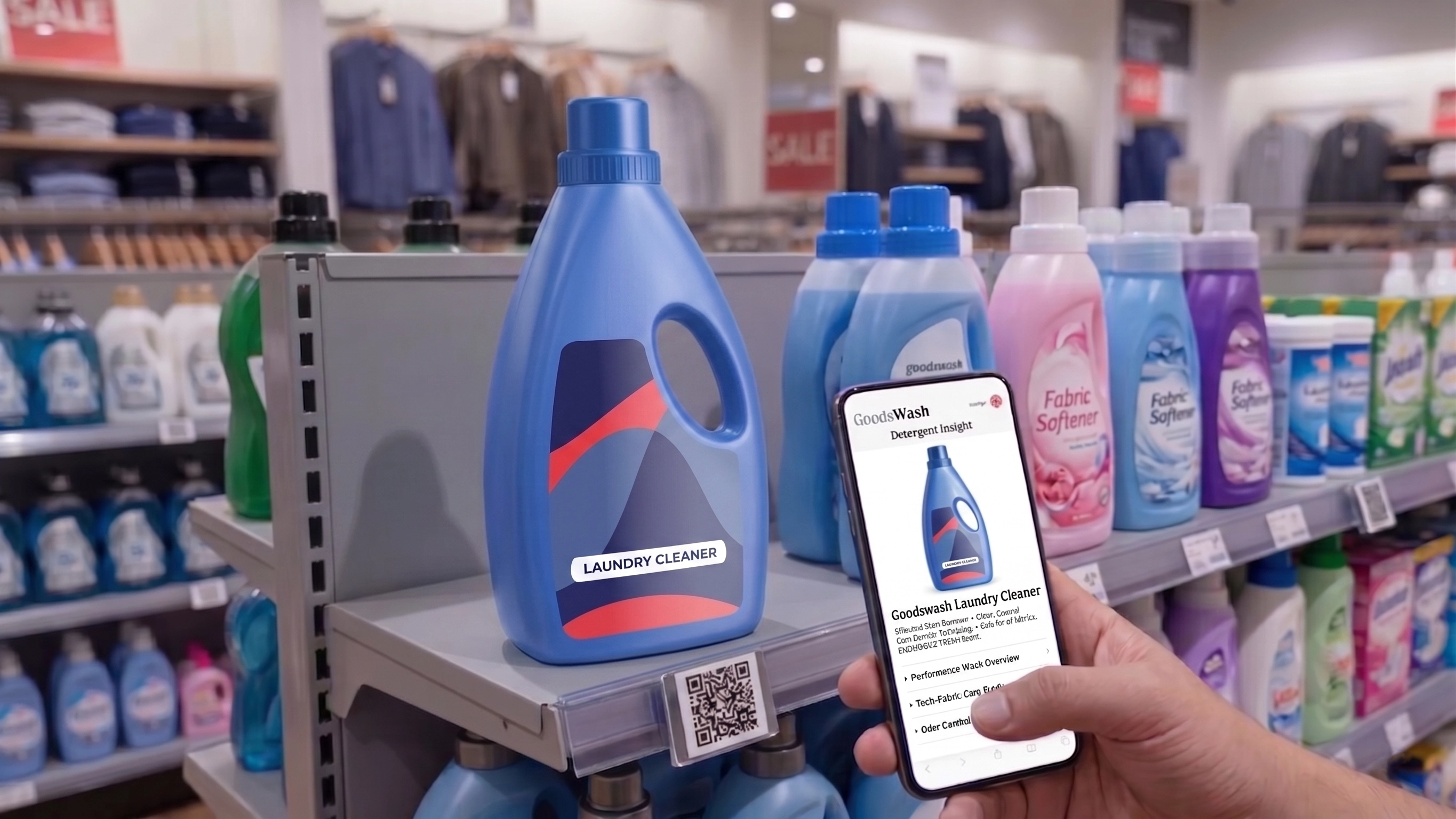
Every detergent must bear a scannable data carrier (such as a QR code, NFC chip, or RFID tag) printed or physically present on its label or packaging. If detergents are sold in bulk via in-store refill stations, the data carrier must be physically present on the refill station itself to ensure that customers can access safety and dosage data before buying.
6. How do we feed all this data into the GoodsTag platform?
GoodsTag features an API-first architecture that seamlessly integrates with your existing enterprise systems, including ERP, PLM, MES, PIM, and supplier databases such as SAP4Hana. Data synchronization is event-driven and supports global GS1 standards like EPCIS 2.0 and GS1 Digital Link for real-time traceability.
7. For how long must the DPP data be stored, and what happens in case of insolvency?
he manufacturer must keep the technical documentation, digital product passport, and digital labels updated and available for 10 years from the date the product model is placed on the market. Crucially, the regulation dictates that the DPP must remain accessible even in the event of insolvency, liquidation, or cessation of activity in the EU. GoodsTag secures this by linking to certified digital passport service providers that host secure, redundant backup copies.
8. How does implementing a Detergent DPP drive commercial value and ROI?
The platform turns the detergent DPP into a powerful commercial asset by building high-quality, privacy-compliant zero- and first-party consumer data directly from on-pack scans and interactions at in-store refill stations. It transforms static cleaning product packaging into a dynamic, post-sale channel that unlocks smart dosage guides, loyalty rewards for refilling, and direct replenishment options. Additionally, the platform provides advanced analytics on consumer usage behavior, packaging circularity metrics, and supply chain efficiency to optimize overall operational ROI.
9. How do we start implementing the DPP, and do we need item-level serialization immediately?
No, item-level serialization (a unique code per individual bottle) is not required on day one, as the physical data carrier on the packaging only needs to resolve at the product model level. However, you still must associate batch-specific data with each product passport. Under the regulations, manufacturers must publish batch information—not via unique on-pack QR codes, but as digital data elements connected to the passport in the background. This ensures that authorized stakeholders, such as market surveillance and customs authorities, can consult current batch records through the central EU DPP registry. GoodsTag’s modular platform allows you to use a cost-effective, model-level QR code on your packaging while our compliance engine automatically manages and syncs the required batch metadata with the EU registry.
10. What types of physical labels or data carriers can be used?
The platform is identity- and label-agnostic. You can seamlessly connect physical garments using QR codes, NFC tags, RFID labels (including UHF, HF, and DualFrequency tags), or DataMatrix codes. It natively supports the GS1 Digital Link standard. You can introduce one ID medium first (like a printed QR code) and easily add further technologies like RFID or NFC later without recreating the digital twin.

The Brands That Move First Will Set the Standard
Build your brand on top of compliance.
The DPP makes product transparency mandatory. Use that transparency to tell your story. The brands that get there first will use it to do something more: tell a better story, earn more trust, and turn supply chain data into a competitive edge.