
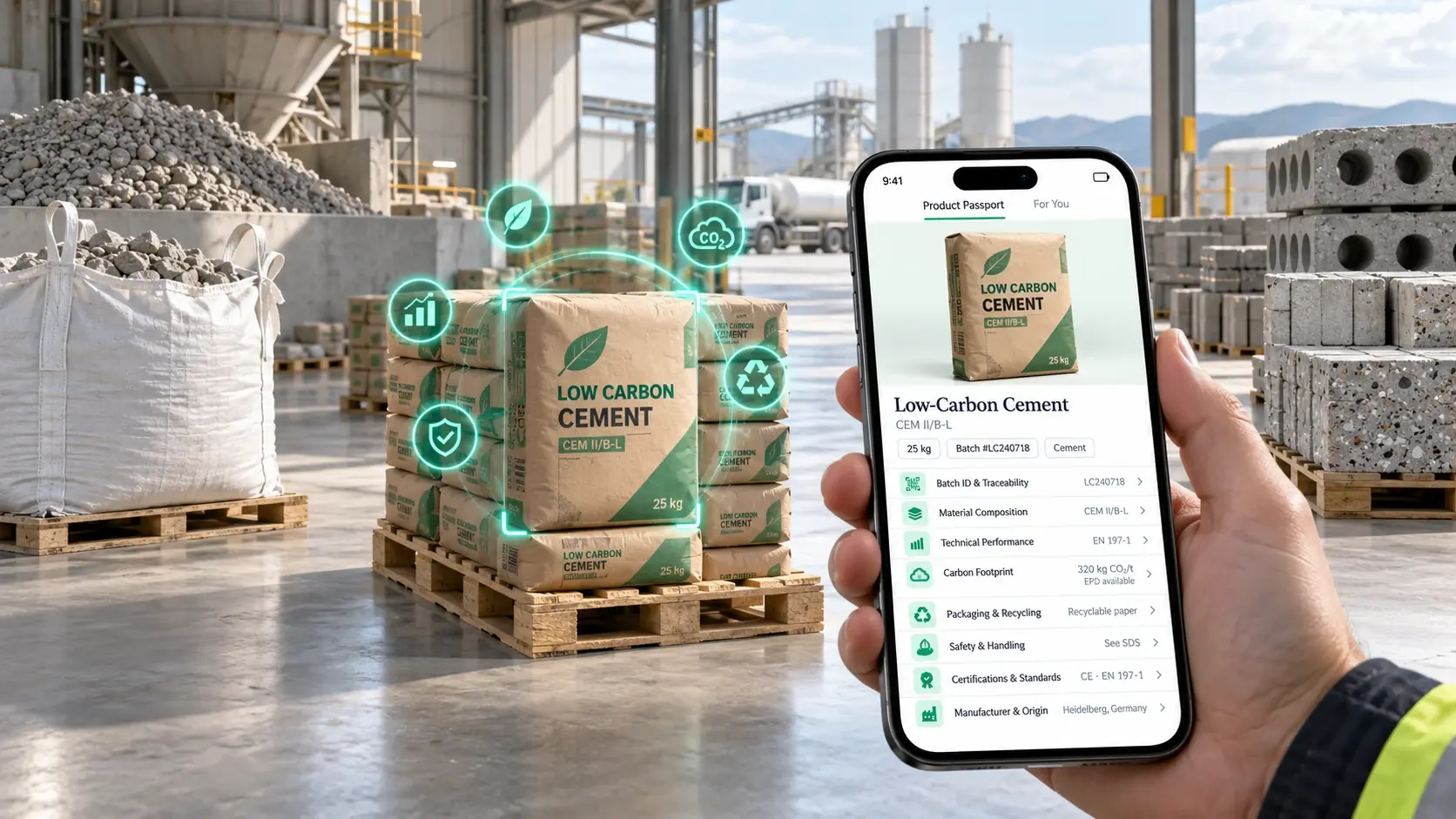
Cement DPP: Product and Material Passports with GoodsTag
GoodsTag provides the infrastructure to create and manage Digital Product Passports for cement and hydraulic binders, carrying verified carbon data for the new Construction Products Regulation, CBAM and low-carbon construction.
Why act now?
Cement Is First in Line: New Standards, Carbon Labels and CBAM.
Cement is the first product family planned under the new Construction Products Regulation, with its revised standards due in 2027 and a mandatory display of its global warming potential announced. Imports already fall under the definitive CBAM regime since 1 January 2026: the first annual declaration for 2026 is due by 30 September 2027.
until the first annual CBAM declaration is due
30 September 2027
First annual CBAM declaration for 2026 imports
What’s Inside a Cement Digital Product Passport?
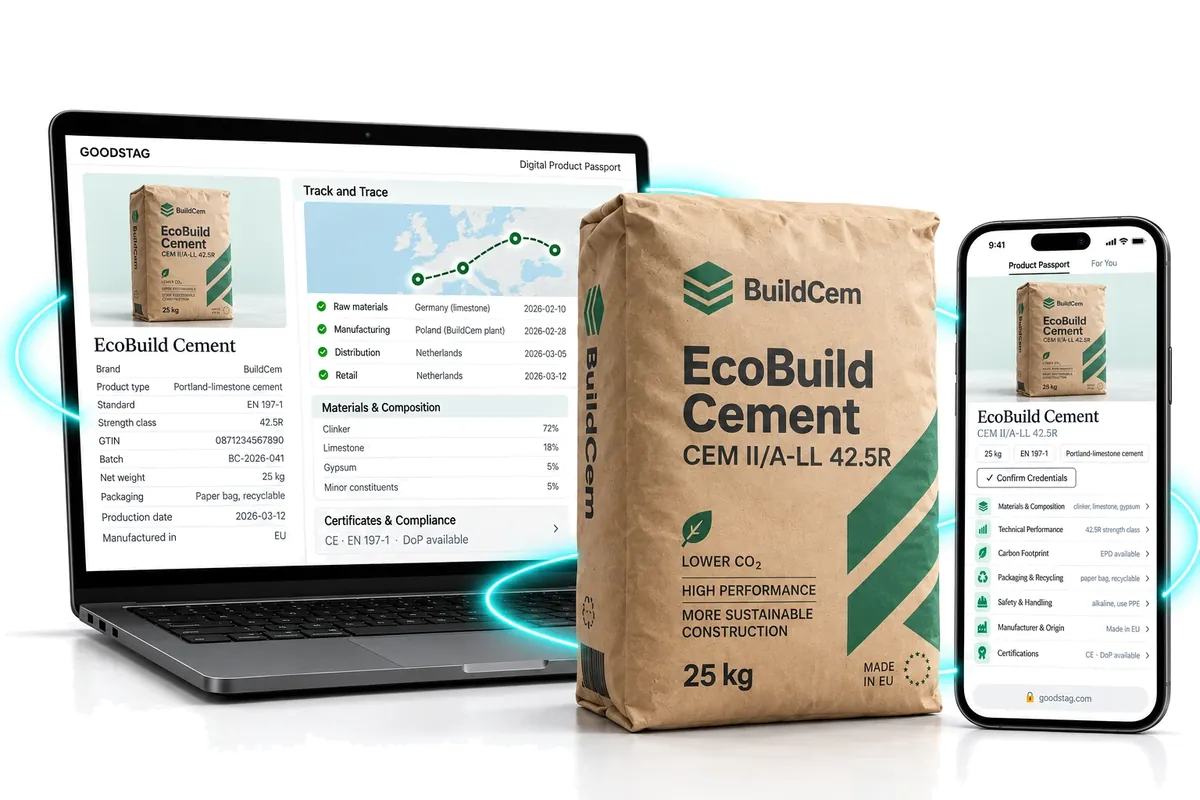
Cement gets its passport from the new Construction Products Regulation (EU) 2024/3110, not from an ESPR delegated act: the ESPR only steps in if the construction rules fall short on cement’s environmental footprint. Cement, building limes and hydraulic binders are the first family planned under the new regulation; the standardisation request of July 2025 asks for revised standards, including EN 197-1, with life-cycle environmental indicators and data templates aligned with the passport system.
Based on the regulation and that standardisation request, a cement passport will draw on:
-
Declaration of Performance and Conformity
The cement type and strength class, its essential characteristics under the harmonised standard, the unique product-type identifier and the REACH information that comes with it
-
Carbon Footprint
Global warming potential for raw material supply, transport and manufacturing (A1–A3), shown as one value, alongside further life-cycle indicators
-
Composition and Secondary Materials
Clinker content, other constituents such as limestone, slag or fly ash, secondary materials and fuels used
-
Linked Material Passports
Links to the passports of clinker, additions and other constituents, so their data flows into the product passport
-
Safety and Handling
Instructions for use, safety information, the label and the technical documentation
All structured, machine-readable, and ready for concrete producers, builders, importers, auditors and authorities.
DPP and DMP
One Product Passport, Linked to Every Material Passport
A bag of cement is a product with its own declaration, and a blend of materials whose carbon footprint decides its value: clinker, limestone, gypsum and other additions. That is why GoodsTag covers both kinds of passport, linked in a parent-child relation, and why your cement passport can in turn feed the concrete made from it.
Digital Product Passport (DPP)
The passport of the cement placed on the market, such as a CEM II bag or a bulk delivery. The Construction Products Regulation sets its content and its delegated act will set the details.
Digital Material Passport (DMP)
The passport of a constituent, such as clinker, limestone or gypsum: origin, composition, emissions and certificates. An industry and research term, not defined in EU law.
EcoBuild Cement CEM II/A-LL 42.5 R, 25 kg
Batch BC-2026-041 · sample data
- Child · DMP
Clinker, 72%
Kiln, fuels, embedded emissions
- Child · DMP
Limestone, 18%
Quarry, composition, origin
- Child · DMP
Gypsum, 5%
Natural or recycled, supplier batch
-
One parent, many children
Each DPP references the DMPs of the constituents it contains, down to the batch, through persistent identifiers.
-
Update once, inherit everywhere
When a constituent’s passport is updated, every cement passport linked to it sees the change.
-
Each party shares what it should
Recipes stay protected: access rights decide which data reaches customers, importers, verifiers or authorities.
There is no EU legal definition of a Digital Material Passport. GoodsTag uses the term for material data structured like a DPP, so it can be linked to product passports.

Need Clarity on Cement DPP Requirements?
Cement sits where construction rules, carbon pricing and building rules meet. We follow every step so you don’t have to.
Digital Product Passport
Cement DPP Experts, Ready to Work With Your Team
End-to-end support to simplify your DPP and DMP rollout.
What’s Getting in the Way of DPP Success?
A cement passport depends on data from kilns, quarries, laboratories and verifiers, plant by plant and batch by batch.
-
Emissions data spread across plants, kilns and fuels
-
EPDs, declarations of performance and test reports in separate systems
-
CBAM data for importers that must match verified installation data
-
Recipes and constituent shares that change between batches
-
Unclear internal ownership
Why Leading Teams Choose GoodsTag for DPPs

Full Lifecycle Support
Your passports stay accurate through new recipes, plants, verified emissions and evolving regulations.

Built for Scale
Handles many cement types, plants and batches, with product and material passports linked to each other.

Compliance in Mind
Your data model follows the CPR passport and the cement standards as they take shape, from the DoPC to the carbon footprint.

Proven Partner
Proven track record in high-stakes, high-volume environments.
How the DPP platform works
The GoodsTag DPP Hub: Connecting Enterprise, Partners and Regulators
From the data you already have to a verifiable passport that every authorised party can read. Designed for interoperability and regulatory compliance.
-
Step 1 · Connect
Your data sources
- Supplier data
- Material passports (DMP)
- ESG and sustainability data
- Business systems: ERP, MES
- PLM and PIM
- Files: PDF, CSV
-
Step 2 · Build
GoodsTag DPP Factory
- Data normalisation and validationSupplier and system data mapped to one structure and checked for completeness.
- Digital twin foundationA digital identity for each product, batch or item, linked to its data carrier.
- DPP–DMP linkingEach product passport is the parent of the material passports (DMP) of its components, linked down to the batch.
- DPP data model translatorYour data mapped to the data model each regulation requires.
- Verifiable credential issuancePassport data signed, so its origin and integrity can be checked.
- DPP event storeEvery creation and change recorded as a versioned, traceable event.
-
Step 3 · Publish
Issued and connected
- EU central DPP registryUnique identifier and link registered with the EU registry, which stores the index, not the passport.
- Public DPP viewProduct ID, material composition, sustainability data, signature check and conformity certificates in one scan.
- Back-up copyA copy of the passport held by an independent DPP service provider, as ESPR Article 10(4) requires.
-
Step 4 · Access
Role-based passport
- AuthoritiesMarket surveillance and customs see the restricted data the law grants them.
- End customersPublic information, free of charge, with no login.
- RecyclersComposition and dismantling data for treatment and recovery.
- Lifecycle partnersRepairers and remanufacturers with a legitimate interest.
Interoperability
Data carriers and standards, GS1 Digital Link conformant, API-first, multiple identity levels from model to item, and role-based data access.
Compliance
Architecture aligned with the regulations and the passport lifecycle, ready for the EU DPP registry, controlled access and GDPR-compliant processing.
Request a live demo
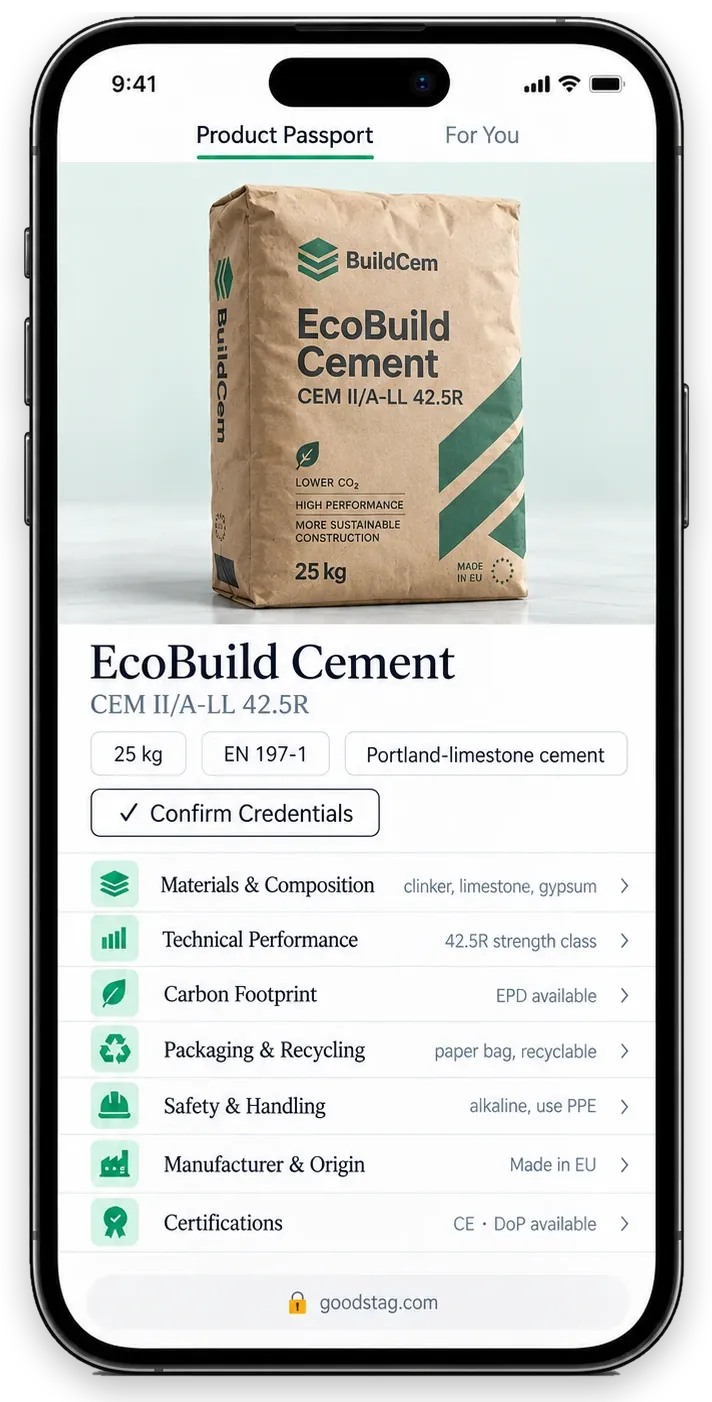
What Could a Cement DPP Look Like?
Builders won’t read a technical file. They’ll scan a QR code on the bag, the delivery note or the silo label.
Here’s an example of what they (and concrete producers and authorities) could see on the other side. Sample data only.
Want to see it with your own products? [Talk to us]
The Deadlines Are Closer Than You Think
Cement is set to be the first product family under the new Construction Products Regulation, and its carbon is already priced at the border. The passport itself depends on a delegated act that has not been adopted yet.
Here are the key dates you need to know about (as of October 2026):






How We Help You Build Your Cement DPP
A simple, practical path for cement producers, grinders, importers and distributors.

Map the data you already have
Lay out all existing data across ERP, plant systems, emissions monitoring, EPDs, declarations of performance and supplier declarations to see where each field currently lives.

Identify missing information
Spot the gaps by separating usable data from incomplete, messy, or missing information, from constituent shares to verified emissions.

Define internal ownership
Assign clear owners for each data area so updates and approvals have defined responsibility.

Align your structure with the EU data model
Match your internal fields to the CPR passport and link each cement to the material passports of its constituents.

Create a publishing workflow
Set a structured workflow for validating, approving, and publishing data into the DPP, the DMP and the declaration.

Plan for ongoing updates
Establish routines and triggers to keep the passports up to date with every new batch, recipe and verified emissions report.
Compliance Without Headaches
Turn the upcoming EU cement requirements into a competitive advantage, today.
Your message has been submitted.
We will get back to you within 24-48 hours.
Frequently Asked Questions
1. What exactly is a Digital Product Passport (DPP) for cement?
A Digital Product Passport is a structured, machine-readable data set that stores verified product information across a product's lifecycle. For cement, it comes from the new Construction Products Regulation (EU) 2024/3110 and holds the Declaration of Performance and Conformity, instructions and safety information, the technical documentation, the label and the unique identifiers, reachable through a data carrier on the bag or the delivery documents.
2. When does the cement passport become mandatory?
No single date is set yet. Manufacturers must provide passports 18 months after the CPR's passport delegated act enters into force, and cement must first move to the new regulation through its revised harmonised standards, planned to become mandatory in Q4 2027 (indicative). As of October 2026, neither step has been completed.
3. Why is cement first under the new CPR?
Cement causes a large share of CO2 emissions, and its standards are being revised to add life-cycle environmental data. The CPR working plan 2026–2029 puts cement, building limes and hydraulic binders first: the Commission's standardisation request of July 2025 asks for a revised EN 197-1 and EN 16908 by 30 June 2027, with machine-readable data templates aligned with the passport system.
4. What carbon information will cement have to show?
The standardisation request asks for life-cycle indicators for raw material supply, transport and manufacturing (modules A1–A3), with the total climate change effect given as one aggregated value. The Commission has also announced a mandatory label displaying the global warming potential of cement once the new cement standards become mandatory.
5. How does CBAM affect cement?
Clinker and cements are covered by the Carbon Border Adjustment Mechanism, Regulation (EU) 2023/956. Since 1 January 2026, importers above 50 tonnes a year must be authorised CBAM declarants, report the embedded emissions of their imports and surrender CBAM certificates. The first annual declaration, for 2026, is due by 30 September 2027; certificates go on sale from 1 February 2027.
6. What happens to free emission allowances for cement?
As CBAM phases in, free allocation under the EU Emissions Trading System is reduced: to 97.5% in 2026, 95% in 2027, 90% in 2028, 77.5% in 2029, 51.5% in 2030 and down to zero from 2034. Verified emissions data per plant becomes a cost factor, and a passport is a structured way to share it.
7. What is a Digital Material Passport (DMP), and how does it relate to the DPP?
A Digital Material Passport is the passport of a constituent such as clinker, limestone or gypsum: origin, composition, emissions and certificates. It is an industry term with no definition in EU law. In GoodsTag the cement's DPP is the parent and the DMPs of its constituents are its children, so the carbon footprint can be traced back to the clinker.
8. Will low-carbon cement be required in public tenders?
Possibly. The Commission's proposed Industrial Accelerator Act, COM(2026) 100, would require from 2029 that a share of the concrete and mortar in public procurement, including the clinker and cement used, be low-carbon as defined under the CPR. It is a proposal and may change before adoption.
9. How do we feed all this data into the GoodsTag platform?
GoodsTag features an API-first architecture that integrates with your existing enterprise systems, including ERP, plant and laboratory systems, EPD tools and supplier databases such as SAP S/4HANA. Data synchronization is event-driven and supports global GS1 standards like EPCIS 2.0 and GS1 Digital Link for real-time traceability.
10. Is the GoodsTag platform ready for the upcoming requirements?
The cement standards and the CPR passport delegated act have not been adopted, so no platform can claim full compliance with them today. GoodsTag builds on the principles the CPR already sets: a data carrier on the product linked to its unique identifier, open and machine-readable formats without vendor lock-in, free access, protection of trade secrets and a back-up copy. Its data models are configurable, so the passport can be mapped as soon as it is defined.

The Producers That Move First Will Set the Standard
Build your brand on top of compliance.
The passport will make the carbon footprint of every cement visible to the people who design, build and buy. The producers that get there first will become the easy choice for low-carbon projects and public tenders, and turn verified data into a competitive edge.