

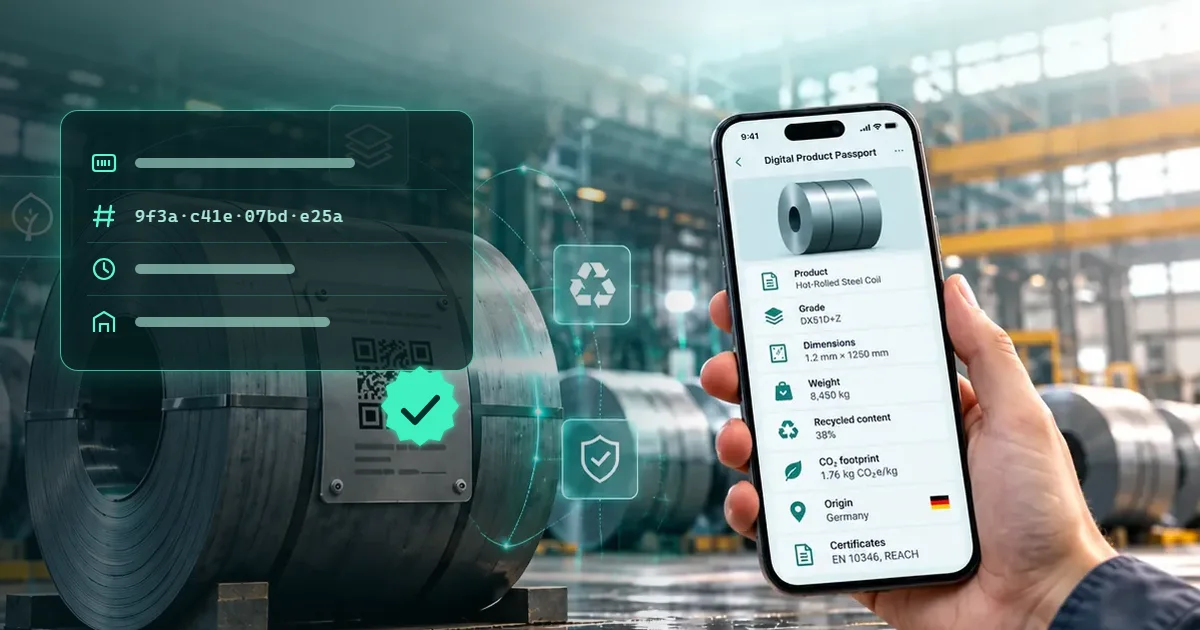
On 20 July 2026, the European Commission launched the EU Digital Product Passport Registry, together with a testing environment. The Ecodesign for Sustainable Products Regulation (ESPR) required the registry to be set up by 19 July 2026, and the Commission Implementing Regulation that governs how it works, (EU) 2026/1778, enters into force on 6 August 2026.
This is an important milestone for Digital Product Passports (DPPs) on the European market. It also raises practical questions for manufacturers and technology teams:
- Does the EU registry store the complete Digital Product Passport?
- Does it verify whether the passport complies with European regulations?
- Must each passport be digitally signed before registration?
- What does the proof of registration actually certify?
- What happens when passport information changes?
The answers matter for every business preparing its DPP infrastructure, and in particular for those facing the battery passport requirements that apply from 18 February 2027: battery passports have to be registered too.
1. What is the EU Digital Product Passport Registry?
The registry is a central component of the European DPP architecture, established by Article 13 of Regulation (EU) 2024/1781 (ESPR). Implementing Regulation (EU) 2026/1778, adopted on 16 July 2026 on the basis of Article 13(5) ESPR, "lays down the implementation arrangements" for it.
One distinction is essential: the EU registry is not a central database holding the content of every Digital Product Passport. The architecture is decentralised. Under Article 13(1) ESPR, the registry stores at least the unique identifiers and, for products to be released for free circulation, the commodity code. Further data may be added by delegated acts (Article 13(2)). The passport itself is stored by the economic operator or by DPP service providers acting on its behalf (Article 11(c) and recital 41 ESPR), and a backup copy must be kept by a DPP service provider (Article 10(4) ESPR). We explain that role in What a certified DPP backup provider does.
The registry also supports customs. Under Article 15 ESPR, customs authorities check the unique registration identifier and the commodity code against the registry. The interconnection with the EU Single Window environment for customs (EU CSW-CERTEX) is due within four years of the implementing act, so around 2030; it is not live yet. For batteries, the Commission's battery FAQ (Q4.1) states that the registration identifier is not entered in the customs declaration.
2. How does DPP registration work?
Implementing Regulation (EU) 2026/1778 sets out the operational procedure. It follows four main steps.
Step 1: Verify the economic operator
Before registering passports, the economic operator has to verify its identity (Article 4). The accepted means rely on the eIDAS trust framework:
- legal persons use a qualified electronic seal or an electronic attestation of attributes (a qualified one for operators established in the EU);
- sole traders use an electronic identification means at assurance level "high" or an electronic attestation of attributes.
The verified status lasts for up to three years (Article 4(4)), after which it has to be renewed.
Step 2: Prepare the DPP and the registration data
The economic operator prepares the passport and the registration data required by the product legislation that applies. In practice, this means the unique product identifier at the right level of granularity (model, batch or item), the commodity code where relevant, and the reference to the backup hosted by a DPP service provider. What exactly is needed depends on the product category and its delegated act or product legislation.
Step 3: Submit the registration
Registration is done through the registry's user interface or through its API (Article 8(6)). The API route suits high volumes and integration with ERP, PLM or product information systems.
Step 4: Receive a registration identifier
After successful registration, the registry generates a unique, persistent registration identifier (Article 8(8)) and communicates it automatically to the economic operator (Article 8(10)). The registered data can then be updated under the applicable rules.
3. What does the EU registry actually verify?
The registry runs automated checks on what is submitted. Article 8(7) of Implementing Regulation (EU) 2026/1778 lists them:
| Check | What it covers |
|---|---|
| (a) Semantic conformity | Structure, format, value type and controlled vocabulary of the data (Article 2(12)) |
| (b) Coherence | Mandatory registry data matches the values in the DPP, where relevant |
| (c) Granularity | Model, batch or item level, as required by the product legislation |
| (d) Commodity code | The code is valid, where relevant |
| (e) Backup link | The link to the backup copy hosted by a DPP service provider, where relevant |
These are technical and formal checks. Recital 16 of the implementing regulation is explicit: verifying the substantive correctness of the information "remains a task for the market surveillance authorities". Passing the registry checks is not proof of compliance.
Example: a battery manufacturer successfully registers a passport with composition, performance and carbon footprint data. That does not establish that every claim in it is accurate. The registry confirms that the registration requirements are met. It does not replace the manufacturer's legal responsibilities, conformity assessment, technical evidence or the work of market surveillance authorities. A registered passport can still contain inaccurate or incomplete product information, which is why companies need their own data validation before and after registration. Who carries that responsibility is the subject of Who is responsible for the Digital Product Passport?.
4. Does every Digital Product Passport need a digital signature?
Digital signatures are a frequent source of confusion, because three different mechanisms are involved.
Identity verification of the economic operator
Qualified electronic seals, attestations of attributes and high-assurance eID are used to verify who the economic operator is before it can register (Article 4 of 2026/1778). They identify the organisation; they do not sign each passport.
Data authentication and integrity
DPP legislation sets requirements for the reliability and integrity of data. Article 78, point (g), of the Battery Regulation (EU) 2023/1542 requires that "data authentication, reliability and integrity shall be ensured". This is an important requirement, but it is not an obligation to apply a qualified electronic signature to every battery passport. Integrity is supported in the registry by a hash of the registered DPP version (Articles 8(9)(d) and 9(2)(e) of 2026/1778).
The proof of registration issued by the registry
This is a separate mechanism: the proof of registration is guaranteed by a qualified electronic seal (Article 9(3), referring to Article 38 eIDAS). It is described in the next section.
No rule in the general framework requires each DPP to be signed with a qualified electronic signature or seal before registration. Specific product rules must still be checked. We look at the battery case in more detail in Is it necessary to sign each battery DPP?.
5. What does the proof of registration contain?
Article 9 of Implementing Regulation (EU) 2026/1778 introduces the proof of registration. It is generated by the economic operator or, where relevant, by a third party on its behalf (Article 9(1)), and it contains at least:
- the unique product identifier;
- the commodity code, where relevant;
- the name and identity of the verified economic operator;
- the date and time of registration of the latest version, validated by an electronic time stamp of the Commission;
- the hash of that DPP version.
The proof is guaranteed by a qualified electronic seal (Article 9(3)) and can be downloaded through the user interface or the API; it remains available for 90 days (Article 9(4)), so it should be stored on the operator's side.
A cryptographic hash is a digital fingerprint calculated from data: when the data changes, the hash changes. It links a specific version of the DPP to the registration evidence. But a hash only shows that a version has not been altered. It does not show that the information in that version is factually correct or legally compliant. Likewise, the seal protects the proof of registration document; it is not the economic operator signing every statement in the passport. The proof documents a registration event. It is not a product compliance certificate.
6. What happens when the passport is updated?
Digital Product Passports are not static documents. Information changes with updated specifications, new evidence, corrections or lifecycle events. Article 10 of the implementing regulation covers this: the registry logs every creation, modification and deletion (Article 10(1)), and "shall support the versioning of the registered data, and store a timestamp of the Commission for each update" (Article 10(2)). Registration data is deleted after 10 years unless Union law sets another period (Article 10(3)).
For businesses, this means distinguishing between:
- the product's persistent digital identity;
- the current version of the passport information;
- the version linked to a given registration event;
- the records of who changed what, and when.
For batteries, changes in status, for example after repurposing or remanufacturing, can bring additional obligations. A practical DPP architecture therefore needs a controlled update process that keeps registry data in sync where required. Publishing a new PDF or overwriting a product web page does not give the necessary control over identity, version history and regulatory information.
7. Batteries: registration from 18 February 2027
From 18 February 2027, electric vehicle batteries, LMT batteries and industrial batteries above 2 kWh need a battery passport (Article 77(1) of the Battery Regulation). Article 77(10), inserted by Article 78 ESPR, requires the unique identifier to be uploaded to the registry referred to in Article 13(1) ESPR. Implementing Regulation (EU) 2026/1778 states that the term "digital product passport" includes the battery passport, and the Commission's battery FAQ (Q2.1) confirms it. Battery passports therefore go through the same registration, checks and proof of registration described above. Questions that are still open for 2027 are covered in EU battery passport 2027: the open questions.
8. What should manufacturers prepare now?
Organisations preparing for mandatory Digital Product Passports should focus on five priorities:
- Reliable product identifiers. Products, models, batches or items must be identifiable according to the legal requirements and the relevant technical standards.
- Structured and validated data. Check completeness, format and reliability of mandatory information before publication and registration.
- Secure data access. Apply the right access rules for public, restricted and commercially sensitive information.
- Lifecycle and version management. Keep control over passport updates and the information linked to each product state.
- Registry integration. Prepare the registration workflow, including operator verification and, for higher volumes, API integration, and keep the proofs of registration.
9. How GoodsTag supports DPP implementation
GoodsTag provides a Digital Product Passport platform that connects physical products with structured digital information. It combines product identification, including GS1-based identifiers, data collection, integration with enterprise systems and digital publication, and is built to manage product information at scale. This helps companies prepare the structured data and processes DPP implementation requires, including evolving product data and integration with the EU registry. The accuracy of the information and the conformity of the product remain the responsibility of the economic operator. Contact GoodsTag to discuss your DPP architecture.
The key takeaway
The EU Digital Product Passport Registry is a key part of Europe's digital product infrastructure. It provides a common registration mechanism, automated technical checks, versioning and a sealed proof of registration. It does not remove the responsibility of manufacturers and other economic operators to ensure that product information is accurate, complete and compliant. A registered passport is not automatically a compliant product. Companies preparing for the next DPP deadlines, starting with batteries in February 2027, need both reliable regulatory information and a robust registration process.
Sources
- Commission Implementing Regulation (EU) 2026/1778 on the Digital Product Passport registry, Articles 2, 4, 8, 9, 10 and 24, recital 16
- Regulation (EU) 2024/1781 (Ecodesign for Sustainable Products Regulation), Articles 10, 11, 13, 15 and 78, recital 41
- Regulation (EU) 2023/1542 on batteries and waste batteries, Articles 77 and 78
- European Commission: The Digital Product Passport registry is now live (20 July 2026)
- European Commission: EU Digital Product Passport FAQ on batteries, Q2.1 and Q4.1
Last regulatory review: 10 October 2026. This article is not legal advice; product-specific requirements and technical implementation guidance should be checked before deployment.