
The EU Batteries Regulation requires digital information for batteries that do not need a battery passport. But does that mean manufacturers must generate a different QR code every time they produce a new batch? Not necessarily. A model-level QR code connected to a searchable batch database offers an alternative worth exploring.
The hidden challenge behind battery QR codes
From 18 February 2027, Regulation (EU) 2023/1542 requires batteries placed on the EU market to carry a QR code providing access to information defined by the Regulation.
For electric vehicle batteries, light means of transport (LMT) batteries and industrial batteries above 2 kWh, the QR code connects to a mandatory digital battery passport.
For three other categories, the requirements are different:
- Portable batteries, including rechargeable and non-rechargeable batteries.
- Starting, lighting and ignition (SLI) batteries, such as automotive starter batteries.
- Industrial batteries with a capacity of 2 kWh or less.
The battery passport of Article 77(1) applies only to LMT batteries, industrial batteries above 2 kWh and electric vehicle batteries, so these three categories need no passport. However, Article 13(6)(b) still requires their QR codes to provide access to applicable regulatory information.
And this creates a practical manufacturing challenge.
Some required information, such as chemistry and nominal capacity, is usually shared across an entire battery model. Other information, including manufacturing location and production date, can vary between batches of that same model.
Does that mean manufacturers must change the QR code whenever the batch changes?
The Regulation does not expressly impose that particular QR-code implementation method. But neither does it explicitly confirm that one model-level QR code is sufficient in every situation.
There may be a more efficient way to organise access to the data.
The concept: one model-level QR code, with batch information behind it
Imagine a manufacturer producing the same industrial battery model throughout the year.
The electrical characteristics, chemistry and product specifications remain unchanged. However, each production batch has its own manufacturing date, factory location and production identifier.
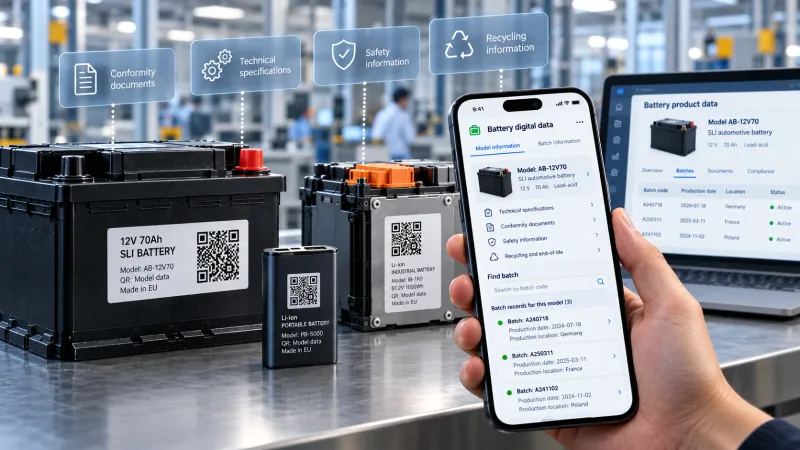
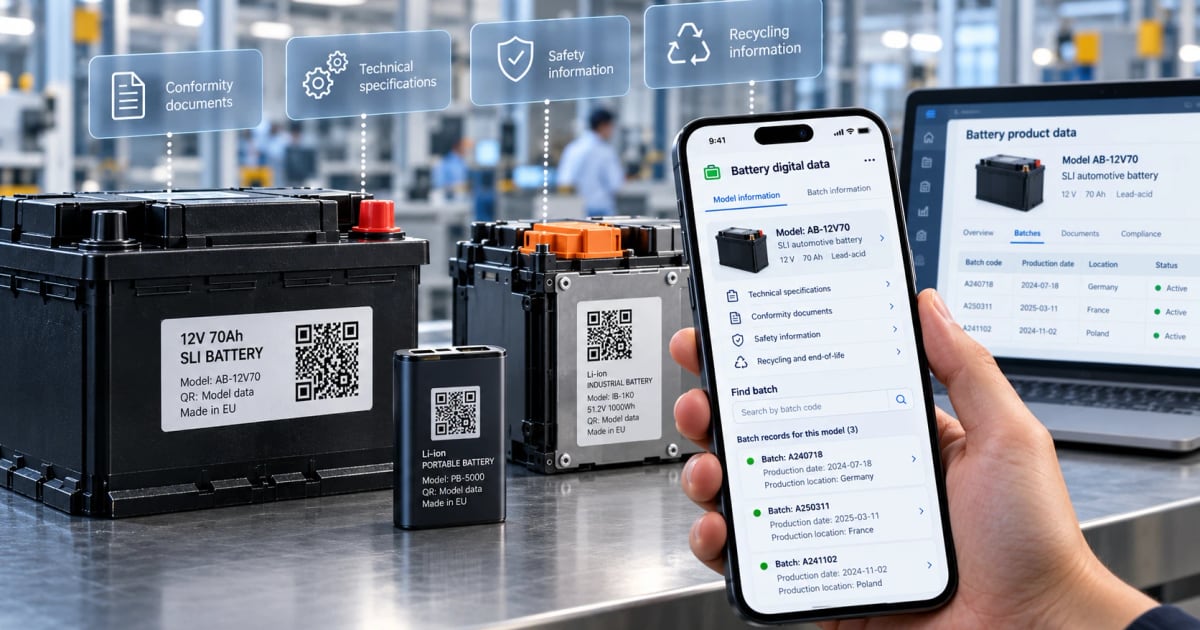
Instead of creating a new QR code for every batch, the manufacturer could use one stable QR code for the battery model.
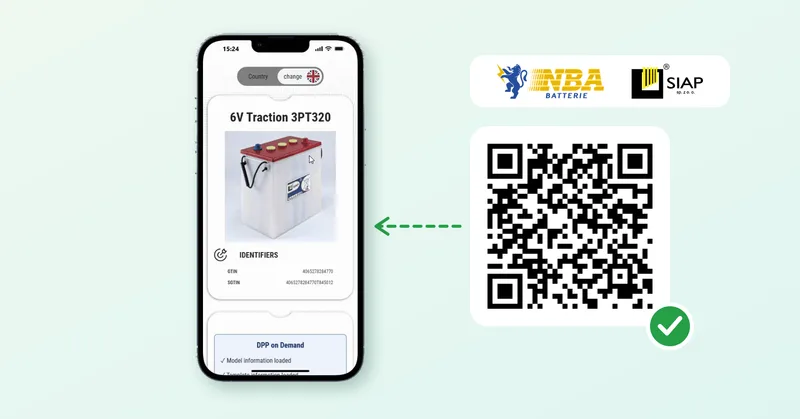
When someone scans it, a digital page opens with the general information for that model.
The visitor can then enter or select the batch identifier appearing on the battery or its accompanying identification information.
The system retrieves the data corresponding to that specific batch.
What would the user experience look like?
For example, a manufacturer produces an industrial battery model identified as IND-240.
All batteries belonging to this model carry the same QR code, which opens the model's digital information page.
The visitor sees the shared model information: manufacturer, chemistry, capacity, technical information, conformity documents and recycling instructions.
A section called Find your production batch allows the visitor to search for a batch identifier.
For illustration:
| Batch | Manufacturing date | Production location |
|---|---|---|
| B2027-001 | January 2027 | Brno, Czech Republic |
| B2027-002 | February 2027 | Brno, Czech Republic |
| B2027-003 | February 2027 | Łódź, Poland |
Illustrative production records.
Selecting the relevant batch opens its production information, while the QR code remains identical across the model.
The manufacturer maintains a single digital entry point, without needing to print a new QR code for every batch.
Crucially, the user must be able to identify and retrieve information about the actual battery concerned. Displaying a generic list of batches without a reliable way to determine the correct one is a weaker approach.
What does the EU Batteries Regulation actually require?
Three provisions are especially relevant.
1. Article 13(6): access to information, not an expressly prescribed QR-code granularity
Article 13(6)(b) requires the QR code of batteries outside the mandatory passport categories to give access to:
- The applicable information referred to in Article 13(1) to (5).
- The EU declaration of conformity referred to in Article 18.
- The due diligence report referred to in Article 52(3), for economic operators subject to the due diligence obligations.
- The waste prevention and management information referred to in Article 74(1)(a) to (f).
For SLI batteries, Article 13(6)(c) additionally requires access to the amount of cobalt, lead, lithium or nickel recovered from waste and present in active materials in the battery, calculated in accordance with Article 8.
The closing sentence of Article 13(6) adds that this information "shall be complete, up-to-date and accurate".
Article 13(6) does not expressly say that every battery batch must have a different QR code. Equally, this absence of an explicit batch-specific QR rule should not be interpreted as unconditional legal approval for every shared-QR implementation.
Legal reference: Regulation (EU) 2023/1542, Article 13(6)
2. Article 38(6): the battery must remain identifiable
Article 38(6) requires manufacturers to ensure that batteries "bear a model identification and batch or serial number, or product number or another element allowing their identification".
Where the battery's size or nature does not allow this, the information must be provided on the packaging or in a document accompanying the battery.
This is an important distinction.
A model-level QR code would not remove the manufacturer's existing battery identification obligations.
However, a physical batch identifier does not necessarily have to be encoded inside the QR code itself. The proposed architecture would use that identifier to retrieve the correct production information from a digital database.
Whether this specific method fully meets Article 13(6)'s access requirement remains a question of legal interpretation and final implementation guidance.
Legal reference: Regulation (EU) 2023/1542, Article 38(6)
3. Annex VI: manufacturing date and location matter
Annex VI, Part A identifies the general information on batteries, including:
- Information identifying the manufacturer.
- The battery category and information identifying the battery.
- The place of manufacture (geographical location of the manufacturing plant).
- The date of manufacture, expressed as month and year.
- Weight, capacity, chemistry and other applicable information.
The general labelling obligations of Article 13(1) to (3) apply from 18 August 2026 or 18 months after the entry into force of the implementing act on label specifications (Article 13(10)), whichever is the latest. As of this article's regulatory review, that implementing act had not been adopted. This is distinct from the fixed 18 February 2027 QR-code deadline.
A digital system capable of connecting a battery identifier to its manufacturing date and location therefore provides a useful foundation for handling this information.
But it does not replace the physical labelling requirements when those become applicable. Article 13(7) requires labels and the QR code to be printed or engraved visibly, legibly and indelibly on the battery, or on the packaging and accompanying documents where the battery's nature and size do not allow it.
Legal reference: Regulation (EU) 2023/1542, Article 13(1), Article 13(7) and Annex VI, Part A
Battery manufacturers have already raised this issue with the European Commission
The operational complexity of batch-specific QR codes is already recognised by the battery industry.
In January 2025, EUROBAT, the association representing European automotive and industrial battery manufacturers, published a white paper on the disclosure of information in battery labels and the battery passport. Its Section III addresses the cost of changing the QR code for every manufacturing month and every batch number.
EUROBAT explicitly identified the three battery categories discussed here: portable batteries, SLI batteries and industrial batteries with a capacity of 2 kWh or less.
The association argued that one QR code for each battery reference would suffice, because the manufacturing date can already be read from the batch number on the battery. It asked that the Commission's implementing act on labelling make clear that these QR codes need not change every month or for every batch.
This is significant: the industry is actively seeking clarification on precisely the manufacturing simplification that a model-level QR architecture could deliver.
The European Commission's draft implementing regulation on battery labelling, notified to the WTO in December 2025, also acknowledges the costs associated with frequently changing manufacturing dates. Its recital (7) calls the date of manufacture a parameter that changes frequently, and the draft allows the date to be printed or engraved elsewhere on the battery, including in the batch or serial number where it is clearly identifiable there.
That flexibility concerns the physical label, not the QR code. The draft had not been adopted as of this article's regulatory review, is not binding legislation, and does not establish that a single QR code per battery model satisfies every information-access obligation.
Sources: EUROBAT white paper, January 2025, Section III and European Commission draft implementing regulation, WTO notification G/TBT/N/EU/1181.
What manufacturers could gain from a shared model-level QR architecture
For manufacturers producing large volumes of identical battery models, the potential operational benefits are substantial.
- Simpler production-line integration. A stable QR code can be incorporated into standard label artwork rather than generated and replaced for every production batch.
- Less variable QR-code printing. Manufacturers may be able to avoid adding batch-specific digital identifiers to their QR-code printing process. Other variable physical markings may still be necessary.
- Centralised digital information management. Model specifications can be maintained in one place, with separate production records linked to the appropriate model and batch identifiers.
- Better traceability and customer access. Distributors, service partners and customers can retrieve batch information when an appropriate identifier is available.
- More flexible information updates. Documents, safety instructions and other applicable information can be maintained in the digital system without automatically requiring a redesign of the QR-code label.
Importantly, these benefits are architectural possibilities, not a regulatory exemption. Any implementation must ensure the correct data is available for the battery concerned.
How GoodsTag can support this approach
GoodsTag enables manufacturers to manage digital battery information through a structured system that can separate common model data from production-specific records.
The proposed workflow is straightforward.
- Create the battery model record. The manufacturer defines the product identifier and associated technical, regulatory and recycling information.
- Connect the model to a stable QR code. The code points to a digital entry page for that battery model.
- Add production batches. New batch records can be imported or synchronised from manufacturing, ERP or traceability systems, with the relevant production date, manufacturing location and batch attributes.
- Provide batch lookup after scanning. The user accesses the model information and can retrieve the corresponding batch details using an identifier from the battery.
- Maintain the information over time. New production batches can be added and relevant information updated without changing the model-level QR-code destination.
The objective is to integrate regulatory information access into the manufacturer's existing production and traceability processes, rather than impose unnecessary printing complexity.
The model-level QR approach should be validated against the final applicable labelling specifications and the manufacturer's particular identification process before being relied upon as a compliance solution.
For the full list of information behind these QR codes, read No Battery Passport Needed? You Still Need Digital Battery Data Behind the QR Code.
One QR code per model: a practical option worth evaluating
The EU Batteries Regulation creates digital information requirements for far more products than those covered by mandatory battery passports.
For portable, SLI and industrial batteries up to 2 kWh, manufacturers need a way to make the required information accessible while maintaining reliable identification and traceability.
A model-level QR code with batch-level lookup could be a practical solution, particularly for high-volume production where the same battery model is manufactured across multiple batches, months or sites.
The commercial opportunity is clear: preserve a stable QR code while giving users access to more specific production information.
The remaining regulatory question is equally important: whether the final interpretation of Article 13(6), together with the applicable labelling specifications, permits this architecture without requiring a QR code directly associated with each production batch.
Manufacturers can start designing for this flexibility today, while keeping their implementation adaptable to further regulatory clarification.
Legal references
- Regulation (EU) 2023/1542, consolidated version of 13 August 2026: Articles 13, 18, 38, 52, 74 and 77; Annex VI.
- EUROBAT white paper on the disclosure of information in battery labels and the battery passport, January 2025: Section III.
- European Commission draft implementing regulation on battery labelling: WTO notification G/TBT/N/EU/1181, December 2025.
- Regulation (EU) 2025/1561: postpones the battery due diligence obligations to 18 August 2027.
Regulatory assessment dated 19 October 2026. This article distinguishes binding legal requirements from an implementation approach that remains subject to clarification. It does not constitute a formal legal opinion.