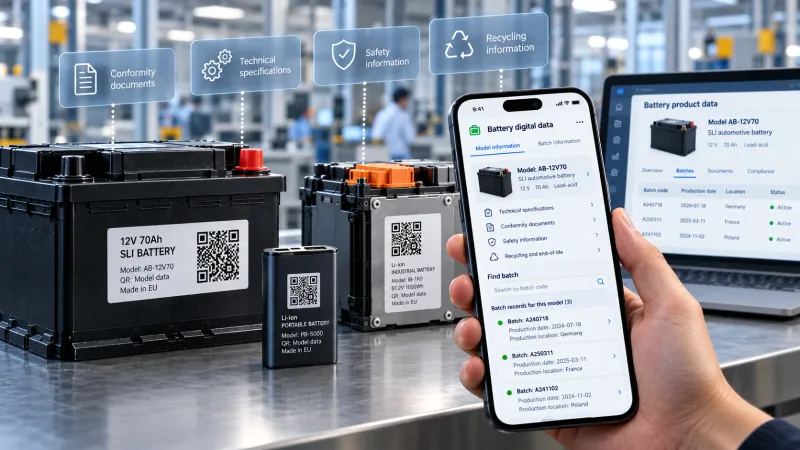

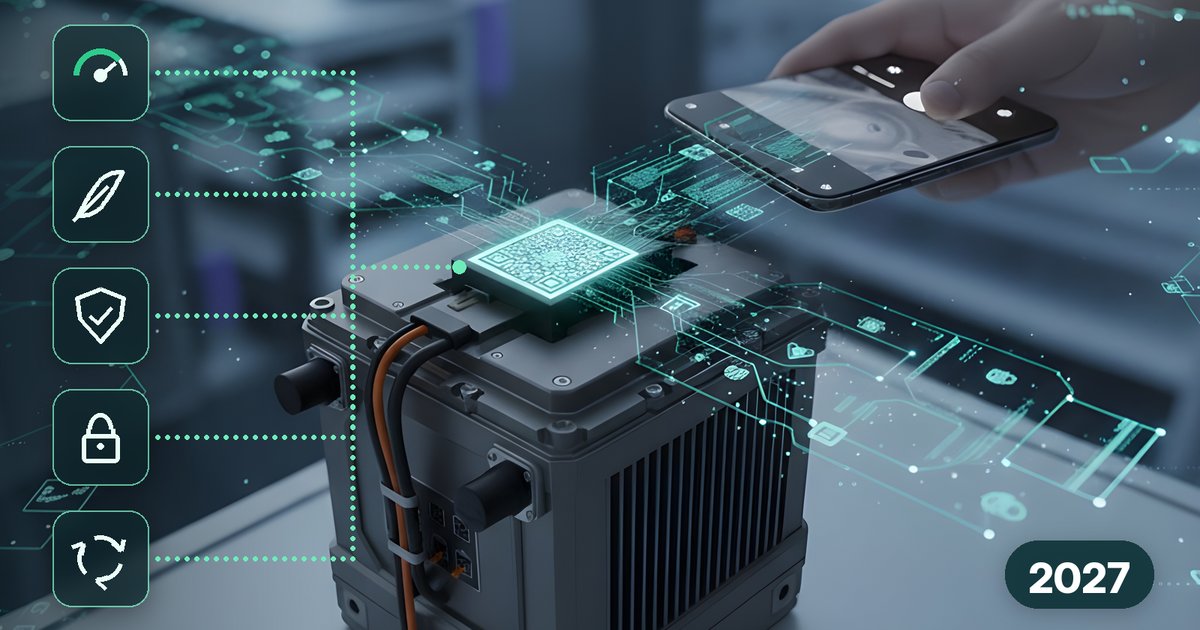
Many companies see the EU battery passport as one more bureaucratic hurdle. Under Article 77(1) of Regulation (EU) 2023/1542, from 18 February 2027 each light means of transport (LMT) battery, each industrial battery with a capacity above 2 kWh and each electric vehicle battery placed on the market or put into service must have an electronic record: the battery passport.
The passport is not a static PDF or a compliance label. It combines information about the battery model with information about the individual battery (Art. 77(2)), and part of that information changes during the battery's life. Used well, it becomes a management tool for how batteries are developed, operated and recycled. Here are five reasons why it is worth more than the obligation behind it, and what the regulation actually requires for each.
1. From a static record to lifecycle data
Annex XIII, point 4 of the regulation lists information specific to the individual battery, including:
- the state of health, as defined in Article 14;
- performance and durability values when they change;
- the battery status: original, repurposed, re-used, remanufactured or waste;
- usage data such as charge and discharge cycles, negative events such as accidents, and periodically recorded temperature and state of charge.
Article 14 requires the battery management system (BMS) to hold up-to-date parameters for determining the state of health and expected lifetime, with read-only access for the person who has legally purchased the battery and third parties acting on their behalf.
The regulation does not require real-time synchronisation between the BMS and the passport. According to the Commission's battery FAQ, dynamic data must at a minimum be updated when the battery's status changes. That is the legal floor. The opportunity lies above it: a company that connects BMS data to the passport in a structured way builds a reliable history of how each battery has been used. That history can support maintenance planning, warranty decisions and the valuation of used batteries.
We look at the open questions around dynamic data in EU Battery Passport 2027: What Is Still Unclear, What Could Change, and How to Prepare.
2. Carbon footprint: proof instead of averages
Article 7 requires a carbon footprint declaration for EV, rechargeable industrial above 2 kWh and LMT batteries, drawn up for each battery model per manufacturing plant. The passport makes that information public (Annex XIII, point 1(c)).
The timing depends on secondary legislation. For EV batteries, the obligation applies from the later of 18 February 2025 and 12 months after the entry into force of the delegated act on the calculation methodology and the implementing act on the declaration format. Neither act had been published in the Official Journal at the time of our last review, so the declaration obligation has not started yet. The Commission's data-point guidance accordingly marks the carbon footprint fields as not to be filled in February 2027.
The direction is clear, though. Because the declaration is plant-specific, a manufacturer that invests in renewable energy and efficient production at a particular site will be able to show that difference to its B2B customers, rather than being measured against an industry average. Collecting energy and supplier data takes time, so starting before the methodology is final is a sensible investment.
3. Responsible sourcing and supply chain resilience
From 18 August 2027, economic operators placing batteries on the market must meet the due diligence obligations of Articles 48 to 52. The date was postponed from 2025 by Regulation (EU) 2025/1561. The obligations cover the raw materials listed in Annex X: cobalt, natural graphite, lithium, nickel and the chemical compounds based on them that are needed to manufacture the active materials of batteries.
The passport makes public the information on responsible sourcing taken from the operator's report on its due diligence policy (Annex XIII, point 1(d)). For companies, the work behind that line is substantial: identifying smelters and refiners, assessing risks and documenting third-party verification. The benefit is a supply chain that can be explained to customers, investors and authorities, and that is better prepared for disruption.
4. Protecting know-how with role-based access
Transparency and trade secrets do not have to conflict. Annex XIII defines three levels of access:
- Public: among other things, the material composition including the chemistry, hazardous substances and critical raw materials, the carbon footprint, responsible sourcing information, recycled content and performance data.
- Persons with a legitimate interest and the Commission: for example the detailed composition, including the materials used in the cathode, anode and electrolyte, part numbers, dismantling information and safety measures. Article 77(2) names repairers, remanufacturers, second-life operators and recyclers among those who need this information.
- Notified bodies, market surveillance authorities and the Commission: for example the test reports proving compliance.
Article 78 requires data authentication, reliability and integrity, and a high level of security and privacy. How persons with a legitimate interest are identified in detail is still open: the implementing act under Article 77(9) had not been adopted at the time of our last review. A passport system therefore needs configurable access levels that can follow the final rules.
5. Unlocking second-life markets
When a battery is prepared for re-use or repurposing, repurposed or remanufactured, responsibility for the passport passes to the economic operator that places it on the market again. Under Article 77(7), the battery then gets a new passport linked to the passport of the original battery. When a battery becomes waste, responsibility passes to the producer, the producer responsibility organisation or the waste management operator. The passport ceases to exist only after the battery has been recycled (Art. 77(8)).
This continuity is what makes used batteries easier to trade. An EV battery that moves into stationary storage brings its documented history with it: state of health, usage and original composition. Buyers can assess it on data rather than assumptions.
A passport that outlives its operator
Article 78(e) requires the battery passport to remain available even after the responsible economic operator ceases to exist or ceases its activity in the EU. The Batteries Regulation does not specify how. A back-up with an independent service provider is a practical way to meet this requirement. For other product groups, the Ecodesign Regulation (EU) 2024/1781 explicitly requires a back-up copy through a digital product passport service provider (Art. 10(4)). We discuss what such a provider has to do in Certified Backup Providers for Digital Product Passports: What Must They Actually Do?
The evolutionary path with GoodsTag
Building this infrastructure takes time, and the battery passport will keep evolving after February 2027 as implementing acts and standards are adopted. GoodsTag supports battery manufacturers along the way:
- a battery DPP platform for model-level and individual battery data, with dynamic updates and configurable access levels;
- linked passports for repurposed and remanufactured batteries;
- data structures prepared for carbon footprint and responsible sourcing information as the rules take effect;
- back-up and continuity services for passport data;
- guidance from our specialists through the EU's technical requirements, so your team is ready on day one.
Is your IT infrastructure ready to link physical batteries to dynamic lifecycle and supply chain records, or are you still relying on static PDF sheets? Contact GoodsTag to turn regulatory compliance into a digital competitive advantage.
Sources
- Regulation (EU) 2023/1542 on batteries and waste batteries, consolidated version of 13 August 2026, Articles 7, 14, 48 to 52, 77 and 78; Annexes X and XIII
- Regulation (EU) 2025/1561, postponement of the battery due diligence obligations
- Regulation (EU) 2024/1781 (Ecodesign for Sustainable Products Regulation), Articles 2(32) and 10(4)
- European Commission: EU Digital Product Passport FAQ - batteries
- European Commission: Digital product passport for batteries, including the data points by category guidance
Last regulatory review: 26 October 2026. The carbon footprint acts under Article 7 and the access-rights act under Article 77(9) had not been adopted at that date. This article is not legal advice.