

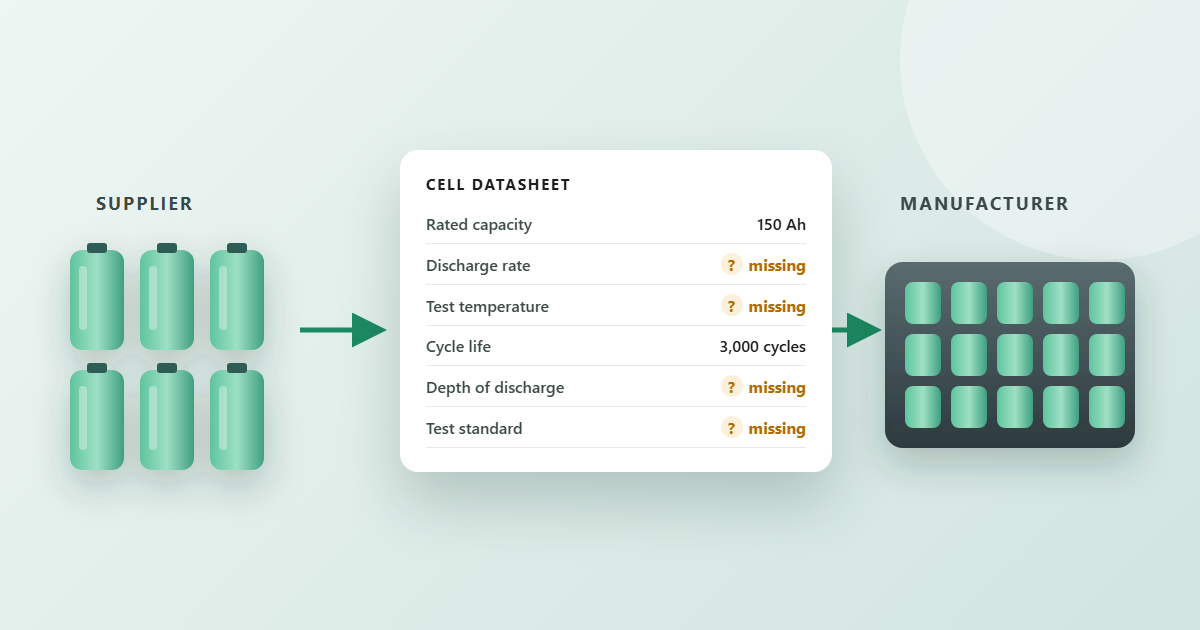
Battery manufacturers and assemblers preparing for the EU Batteries Regulation often face the same challenge: getting the technical information they need from their cell and module suppliers.
Sometimes suppliers provide only basic product specifications. In other cases, performance values are available, but the test methods, calculation procedures and measurement conditions behind them are missing. This is a real compliance problem, especially for manufacturers that assemble batteries from components made by others.
The good news: Regulation (EU) 2023/1542 explicitly requires suppliers of battery cells and modules to provide the information and documentation manufacturers need to comply. But what exactly must suppliers provide, and what can manufacturers do when essential data is not available?
1. Cell and module suppliers have a legal obligation to provide compliance data
Article 39, "Obligations of suppliers of battery cells and battery modules", is clear: suppliers "shall provide the information and documentation necessary to comply with the requirements of this Regulation when supplying battery cells or modules to a manufacturer". And: "That information and documentation shall be provided free of charge."
A cell or module supplier therefore cannot treat all regulatory information as optional commercial data. Where specific information is necessary for the manufacturer's compliance, Article 39 provides a legal basis for requesting it.
Two distinctions matter:
- Scope. Article 39 concerns suppliers of battery cells and modules. It does not automatically put the same obligation on suppliers of finished batteries or unrelated components.
- Necessity. The obligation covers information and documentation necessary for compliance. It is not a right to every internal document, laboratory record or trade secret of the supplier.
Manufacturers should therefore make targeted requests that name the regulatory requirement each piece of information supports.
2. Values alone are not enough: methods and conditions matter
One of the most important requirements is often overlooked. Since 18 August 2024, Article 10(1) requires rechargeable industrial batteries above 2 kWh, LMT batteries and electric vehicle batteries to be accompanied by a document with values for the electrochemical performance and durability parameters of Annex IV, Part A: rated capacity and capacity fade, power and power fade, internal resistance and its increase, energy round-trip efficiency and its fade where applicable, and the expected lifetime.
The Regulation does not only require the values. The technical documentation must contain "an explanation of the technical specifications, standards and conditions used to measure, calculate or estimate the values". According to Annex IV, Part B, that explanation includes at least:
- the applied discharge rate and charge rate;
- the ratio between nominal battery power (W) and battery energy (Wh);
- the depth of discharge in the cycle-life test;
- the power capability at 80% and 20% state of charge;
- any calculations performed with the measured parameters, if applicable.
Article 15 adds that tests, measurements and calculations must use "reliable, accurate and reproducible methods" whose results "are deemed to be of low uncertainty".
Take a simple example: a cell supplier declares a rated capacity of 150 Ah. Is that enough? Not necessarily. To judge whether the value is relevant and valid, a manufacturer may need to know:
- at which discharge rate the capacity was determined;
- at which temperature it was measured;
- which end-of-discharge voltage was applied;
- which test standard and procedure were used;
- whether the figure is a measurement, a calculation or an estimate;
- which technical evidence supports it.
A value measured at one discharge rate or temperature is not directly comparable with one obtained under other reference conditions. The same applies to the other parameters:
| Performance parameter | Supporting information to request |
|---|---|
| Rated capacity | Discharge rate, temperature, cut-off voltage, test method |
| Internal resistance | Cell or pack level, AC or DC method, temperature, state of charge, measurement conditions |
| Cycle life | Depth of discharge, charge and discharge rates, temperature, end-of-life threshold, reference test |
| Power capability | State of charge, temperature, load duration, voltage and current limits |
| Energy round-trip efficiency | Measurement boundary, charge and discharge procedure, temperature, state-of-charge window |
These are practical examples of evidence to request. The documentation legally required depends on the parameter, the applicable standards and the conformity assessment. Under Annex VIII, the technical documentation contains, where applicable, "the results of design calculations made and the examinations carried out, and the technical or documentary evidence used" and "the test reports". The goal is not to collect numbers, but to make sure every declared value can be justified and its conformity verified.
3. Cell data and finished-battery performance are not interchangeable
This matters most for battery assemblers. A supplier may provide reliable data for a single cell, but an assembled pack has its own electrical and performance characteristics, shaped by cell configuration, interconnections, thermal management, the battery management system and other components.
The Regulation distinguishes cell-level and battery-level information. Annex XIII, for example, requires "internal battery cell and pack resistance" in the battery passport, while values such as rated capacity, power capability and expected lifetime must describe the finished battery the requirements apply to.
A manufacturer cannot assume that a cell supplier's test results represent the assembled battery. Depending on the parameter, the manufacturer may need to:
- use supplier measurements as inputs to its own calculations;
- test the assembled battery;
- develop technically justified models based on representative measurements;
- validate calculated or estimated values through suitable testing.
Where modelling or estimation is used, the method must suit the requirement, and the underlying evidence must be reliable. The Regulation does not require every battery configuration to go through a complete life-testing programme, but representative tests or engineering models do not remove the obligation to justify the declared values.
4. What can manufacturers do when suppliers do not provide the information?
Option 1: Send a formal, regulation-based data request
Move beyond an informal request for specifications. Send a structured data request that refers to Article 39 and clearly identifies the information and supporting documentation needed. For each attribute, specify the expected value, unit, applicable standard or method, test conditions and supporting evidence. Set a deadline, list missing documents and keep written records of requests and answers. This creates a clear compliance trail and avoids misunderstandings.
Option 2: Build a structured supplier data process
For recurring suppliers, compliance data belongs in procurement and supplier qualification: standard data templates, contractual documentation requirements, and a procedure for updates when cell specifications or manufacturing processes change. Where suppliers worry about confidentiality, options include non-disclosure agreements, restricted access to technical reports, secure document exchange, or verification by an agreed independent third party. These arrangements help put Article 39 into practice, but they do not replace it.
Option 3: Test independently
When information cannot be obtained, manufacturers can test internally or with a qualified external laboratory. The documentation should identify the methods, reference conditions, measurements, calculations and evidence behind each declared value. This works well for finished-battery performance, but long ageing and cycle-life tests take time and money, and testing does not provide upstream information such as detailed material composition.
Option 4: Use validated calculations and representative testing
For manufacturers with many battery configurations, testing every combination may be impractical. A technically justified approach groups comparable designs, tests representative configurations and uses suitable engineering models for certain attributes, provided the approach meets the requirements for reliability, accuracy, reproducibility and uncertainty. Document the modelling assumptions and validation evidence. Estimates without a defensible technical basis should never be presented as verified regulatory values.
Option 5: Escalate unresolved supplier non-compliance
If a cell or module supplier keeps withholding necessary documentation, escalate through procurement, quality and legal: review contractual obligations, get legal advice on enforcing Article 39, ask the competent or market surveillance authority for guidance, and assess alternative suppliers. Where a mandatory requirement cannot be demonstrated, the gap must be closed before the battery is placed on the market or put into service. A supplier's refusal does not exempt the manufacturer.
5. Who is ultimately responsible?
Article 39 sets obligations for cell and module suppliers, but Article 38 makes the manufacturer responsible for the conformity of the finished battery: designing and manufacturing it in accordance with the requirements, drawing up the technical documentation and carrying out the applicable conformity assessment. In addition, Article 77(4) requires the economic operator placing a passport-covered battery on the market to ensure that the passport information is "accurate, complete and up to date".
A manufacturer can rely on supplier information, but collecting a datasheet does not by itself establish compliance. Supplier data collection and technical validation have to be managed together.
6. Managing supplier data for the battery passport
From 18 February 2027, electric vehicle batteries, LMT batteries and industrial batteries above 2 kWh placed on the EU market need a battery passport. Annex XIII covers identification, technical characteristics, performance and durability, materials and other regulatory information, with different levels of access: much model-level performance information is public, while "results of test reports proving compliance" are accessible only to notified bodies, market surveillance authorities and the Commission.
Manufacturers therefore need to separate the information published in the passport from the supporting evidence they keep for conformity assessment. A good data management approach lets them:
- identify which attributes apply to each battery category and model;
- determine which information comes from cell or module suppliers and which they produce themselves;
- track missing, incomplete or outdated supplier information;
- keep the origin and evidence of every declared value;
- connect validated company, model and battery data to the passport;
- manage access to confidential and restricted information.
7. How GoodsTag supports battery manufacturers
GoodsTag helps battery manufacturers and assemblers structure and manage the information their battery passports need. By organising data at company, battery model and individual battery level, GoodsTag consolidates information from multiple suppliers and manufacturing systems, helps identify data requirements and gaps, and connects validated product information to the digital passport. The technical evidence and the conformity assessment remain the responsibility of the economic operators concerned.
The key takeaway
Battery passport compliance starts long before QR codes or publication. It starts with reliable, properly documented information from the supply chain. For cell and module suppliers, providing the necessary compliance documentation is a legal obligation. For battery manufacturers, verifying and managing that information is essential to demonstrating conformity. When supplier information is missing, there are practical alternatives, but no shortcut around supporting every regulatory declaration with defensible technical evidence.
Sources
- Regulation (EU) 2023/1542 on batteries and waste batteries, Articles 10, 15, 38, 39 and 77, Annexes IV, VIII and XIII
This article reflects the legal situation as of 8 October 2026 and is not legal advice.